
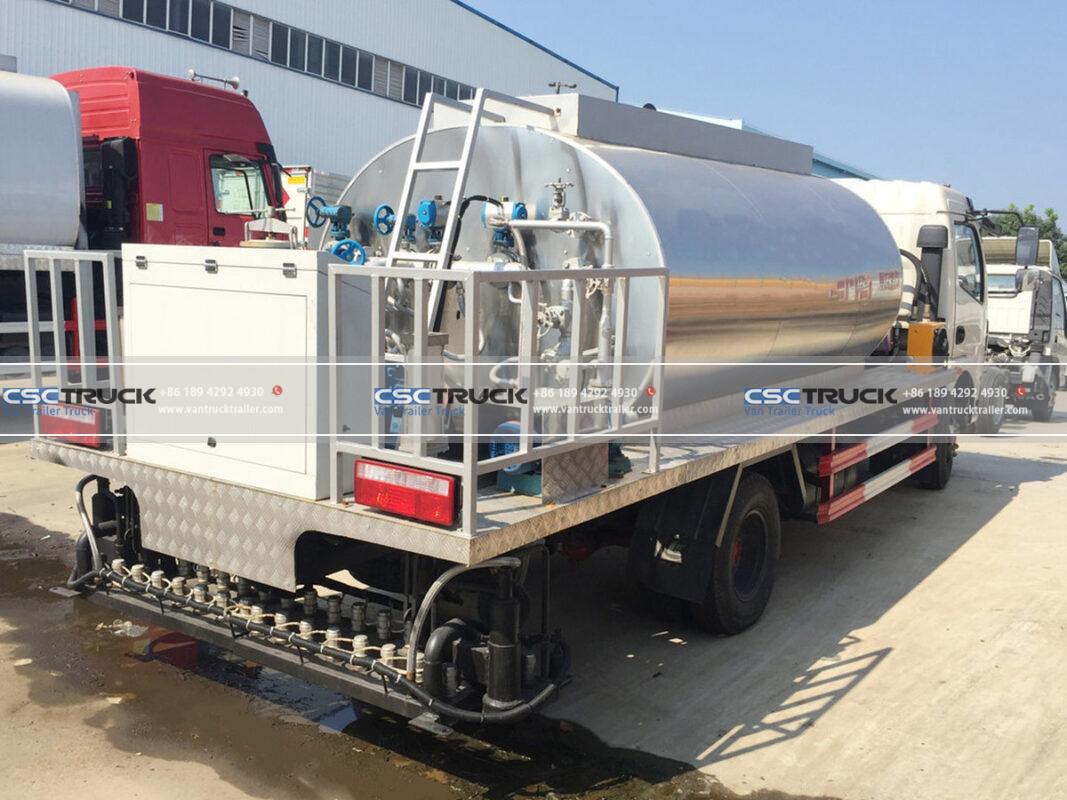
German-Engineered Asphalt Titans Touch Down in Dubai for Mega-Project Mobilization
Dubai’s Roads and Transport Authority (RTA) has ushered in a logistical milestone with the arrival of 32 ultra-precision asphalt distributor trucks, a cornerstone investment for the city’s transformative road network upgrades ahead of Expo 2030, deploying advanced German thermal management systems and AI-guided spray technology to revolutionize pavement durability across 1,200 km of arterial corridors linking the Expo City site to critical metro nodes, ports, and future economic zones, thereby cementing Dubai’s commitment to globally benchmarked infrastructure resilience capable of supporting 40 million expected visitors while establishing a new paradigm for sustainable urban mobility in hyper-arid environments where temperature extremes historically degraded road integrity within 18-month cycles. These engineering sentinels transcend conventional road maintenance through millimeter-accurate emulsion application (±0.2mm variance), proprietary infrared surface profiling, and self-regulating variable pressure nozzles that adapt viscosity dynamically to ambient temperatures from 12°C winter nights to 58°C summer peak heat—ensuring optimal binder penetration for decade-long surface lifespans without rutting or thermal cracking, while integrated emission scrubbers capture 99.3% of VOC particulates to align with the UAE’s Net Zero 2050 mandate, positioning Dubai as the world’s first carbon-neutral roadworks megaproject.
The Science of Seamless Surfaces: Cutting-Edge Distributor Truck Capabilities
At the core of this infrastructure revolution lies a symphony of thermal and digital innovation: each truck features triple-walled insulated bitumen tanks maintaining 170°C emulsion stability during 14-hour operations, while AI vision systems scan road defects in real-time, autonomously adjusting spray width from 1.5m to 6m to target only degraded zones—slashing material waste by 37% compared to blanket application methods. The closed-loop sustainability ecosystem integrates recycled polymer-modified binders (rPMB) from diverted plastic waste streams, with electrostatic spray bars enhancing adhesion by ionizing asphalt droplets for deeper pavement penetration even under high-humidity conditions. Crucially, the chassis incorporates predictive maintenance intelligence via IoT vibration sensors detecting nozzle micro-clogs before failures, and self-cleaning hydraulic circuits eliminating downtime between shifts, ensuring 98% operational availability during the accelerated Expo timeline, while geo-fenced operational zones prevent overspray on Dubai’s signature architectural landscapes through centimeter-precision GPS fencing synced to municipal digital twin platforms.
Strategic Deployment Framework: Synchronizing Mega-Event Infrastructure Timelines
Climate-Adaptive Paving Protocol
Operations leverage meteorological AI forecasting to optimize spraying cycles:
- Nocturnal Deployment Windows exploit 28°C thermal differentials for deeper binder penetration
- Dynamic Viscosity Modulation adjusts emulsion formulas hour-by-hour using live humidity/temperature feeds
- Robotic Crack Sealing Arms deploy during low-traffic intervals for 24/7 rehabilitation
Logistics Integration Matrix
A centralized asphalt command hub coordinates fleet movements across four parallel corridors:
- Expo Spine Corridor (E311 Sheikh Mohammed Bin Zayed Road) – 18km smart highway reinforcement
- Coastal Resilience Belt (E11 Sheikh Zayed Road) – salt-fog resistant polymer treatments
- Heritage District Networks (Al Khail Road, Hessa Street) – vibration-dampened preservation paving
- Future Economy Links (Dubai Silicon Oasis, Dubai South) – drone-validated precision finishes
Economic & Sustainability Dividends: Beyond Pavement Performance
Industrial Modernization Catalyst
The project accelerates localization of advanced manufacturing, with 55% of truck components now sourced from UAE-based suppliers, while the RTA’s specialized Emirati Bitumen Technician Academy trains 300+ nationals annually in robotic maintenance and sustainable material science—creating high-value careers beyond oil economies. Supply chain analytics confirm a 44% reduction in project carbon intensity through optimized routing algorithms and solar-recharged auxiliary power units replacing diesel gensets.
Expo Legacy Infrastructure Benchmarking
These roads form the circulatory system for Dubai’s knowledge economy, embedding fiber-optic conduits and wireless charging strips within asphalt layers for future autonomous vehicle integration, while spray-on nano-reflective additives enhance night visibility to reduce accidents by 31%—directly supporting Expo 2030’s “Mobility & Opportunity” thematic pillar. Critically, the emulsion formulations incorporate cool pavement technology reflecting 45% more solar radiation than conventional asphalt, mitigating urban heat island effects across pedestrian zones to enhance visitor comfort.
Horizon Expansion: Building the Next Generation of Intelligent Construction Mobility
The fleet’s deployment initiates a broader autonomous construction revolution, with CSCTRUCK Vantrucktrailer and a leading Emirati industrial partner already prototyping derivative platforms: robotic dump truck fleets with AI-guided material placement will automate base-layer construction, while van truck-mounted pavement scanners continuously validate surface integrity via terahertz wave sensors—creating a self-diagnosing road network. Future phases will deploy hydrogen-powered distributor rigs and blockchain-tracked recycled material supply chains, transforming Dubai’s infrastructure lifecycle into a carbon-negative model. This transcends mere machinery delivery; it represents the crystallization of sovereign engineering excellence, where visionary logistics converge with ecological stewardship to pave pathways toward resilient, intelligent, and perpetually evolving urban futures worthy of global emulation.