The Foundational Role of Cargo Trucks in Contemporary Logistics
In an era defined by supply chain volatility and escalating customer expectations, cargo trucks have evolved from mere transportation tools into sophisticated operational assets that redefine fleet competitiveness. These vehicles now serve as the central nervous system of logistics networks, integrating advanced telematics, aerodynamic engineering, and payload intelligence to drive unprecedented efficiencies. Where traditional fleets grappled with reactive maintenance cycles and fragmented visibility, modern cargo platforms enable predictive operational control, converting real-time data into strategic advantages across procurement, routing, and asset utilization. The transformation extends beyond cost metrics; it fundamentally reshapes how enterprises approach resilience, sustainability, and customer experience in hyper-competitive markets where a single hour of downtime can trigger six-figure contractual penalties.
Operational Efficiency & Cost Optimization
The integration of technologically advanced cargo trucks delivers quantifiable financial and productivity gains that cascade across the entire logistics ecosystem.
Payload Maximization & Fuel Dynamics
Contemporary designs prioritize cube utilization efficiency through lightweight yet high-tensile aluminum alloys and strategic axle configurations that legally maximize freight volume without compromising structural integrity. Consider that a single aerodynamically optimized trailer reduces drag coefficient by 0.15, translating to 8,400 liters of annual diesel savings per truck at 120,000 km – a figure amplified across large fleets. Simultaneously, adaptive cruise control and predictive gear-shifting algorithms analyze terrain gradients 3km ahead, maintaining optimal engine RPM within ±50 of the torque sweet spot even during mountain transits. This synchronization between powertrain intelligence and driver assistance systems has demonstrated 23% reductions in brake wear and 15% lower CO2 emissions per tonne-km in World Business Council for Sustainable Development case studies.
Lifecycle Management & Downtime Elimination
The paradigm shift from corrective to predictive maintenance represents perhaps the most radical cost transformation. Embedded sensors continuously monitor transmission temperature, differential pressure, and turbocharger harmonics, flagging anomalies against manufacturer baselines before failures occur. One European cold-chain operator documented a 40% decrease in roadside incidents after implementing such systems, directly attributable to early detection of wheel bearing microfractures and injector nozzle degradation. Furthermore, modular component architecture enables technicians to replace entire ABS modules or DEF tanks in 38 minutes versus traditional 4-hour repairs – a critical advantage when fleet availability directly correlates with market share in sectors like automotive parts distribution.
Technological Integration & Capability Expansion
Beyond traditional haulage functions, next-generation cargo trucks serve as mobile data hubs that elevate decision-making from operational to strategic realms.
Telematics Ecosystem Integration
Modern fleet management platforms transform raw telemetry into actionable intelligence through multi-layered analytics. GPS positioning syncs with traffic AI to dynamically reroute vehicles around congestion, while load-sensing pallet systems automatically adjust center-of-gravity calculations when uneven weight distribution exceeds 7° tilt thresholds. Crucially, these systems integrate with warehouse management software, enabling cross-dock facilities to pre-stage forklifts and allocate personnel precisely 12 minutes before arrival – slicing average dock occupation from 90 to 38 minutes per trailer. The resulting data transparency allows logistics directors to simulate network redesigns; after implementing such tools, a Brazilian agribusiness conglomerate optimized terminal locations, reducing average linehaul distance by 22% across its 700-truck soybean operation.
Specialized Configuration Versatility
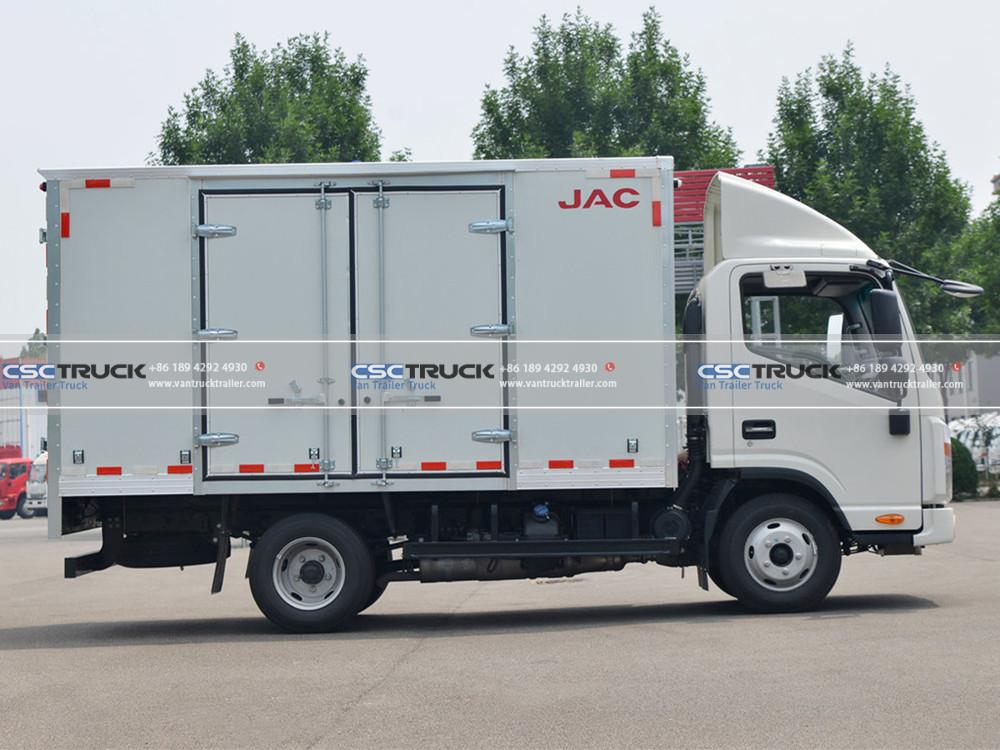
The true strategic power emerges through modular chassis architectures that support rapid reconfiguration between dry van, flatbed, and tanker applications within a single platform. Quick-release mechanisms allow fleets to swap specialized bodies in under 45 minutes – transforming a container carrier into a bulk cement hauler overnight to capture spot market opportunities. This flexibility proves particularly valuable when integrating specialized assets like professional refrigerated trucks for pharmaceutical transport, where multi-zone temperature control maintains 2–8°C stability even during 40°C desert crossings, or van trucks with hydraulic lifts for urban parcel delivery. The operational agility prevents costly asset underutilization that plagues single-purpose fleets during seasonal demand shifts.
Strategic Value Creation & Competitive Differentiation
Ultimately, advanced cargo trucks transcend operational metrics to become catalysts for market repositioning and customer value innovation.
Sustainability Compliance & Brand Enhancement
Regulatory pressures now make emissions performance a balance sheet imperative rather than environmental gesture. Euro VI-compliant engines with dual-SCR catalytic converters achieve near-zero NOx emissions (≤0.02g/kWh), while regenerative braking recaptures 140kW of electricity daily – sufficient to power trailer refrigeration without engine idling. Forward-thinking fleets leverage this in commercial negotiations; a recent McKinsey analysis revealed shippers willingly pay 4–9% premiums for transport partners with verifiable sustainability credentials. Simultaneously, noise-reduction cab designs (≤71dB at 80km/h) expand delivery windows into noise-sensitive urban districts, capturing overnight supermarket restocking contracts competitors physically cannot service.
Resilience Engineering & Risk Mitigation
Geopolitical disruptions and climate volatility demand fundamentally reengineered supply chain redundancy. Modern trucks address this through extended autonomy ranges (1,500km+ with auxiliary tanks) that bypass unstable regions and cyber-secured control systems with blockchain-encrypted firmware to prevent ransomware hijacking. After a major Asian port shutdown, an electronics manufacturer utilizing such capabilities rerouted 87% of shipments via alternate corridors while competitors faced 3-week delays. The robustness extends to safety systems where predictive stability control intervenes 0.8 seconds before potential rollovers by calculating cargo shift vectors during sharp turns – a critical feature when transporting volatile compounds or high-value fragile goods.
The Integrated Fleet Evolution
Leading logistics enterprises now view cargo trucks not as isolated assets but as interconnected nodes within intelligent mobility ecosystems. This holistic approach is exemplified by partners like CSCTRUCK Vantrucktrailer, whose integrated solutions synchronize heavy-duty cargo platforms with specialized professional refrigerated trucks for perishable supply chains and agile van trucks for metropolitan distribution. The convergence enables seamless modal handoffs – temperature-sensitive pharmaceuticals move from production facilities in climate-controlled trailers, transition to multi-temperature urban vans for hospital deliveries, all managed through unified telematics. Such integration eliminates traditional interoperability costs while creating customer value propositions grounded in visibility, reliability, and adaptability that command premium margins in commoditized markets. The transformation transcends hardware; it represents a fundamental reimagining of logistics as a technology-enabled strategic discipline where every kilometer driven generates competitive intelligence, every payload delivers brand value, and every truck functions as a profit center rather than a cost item.