
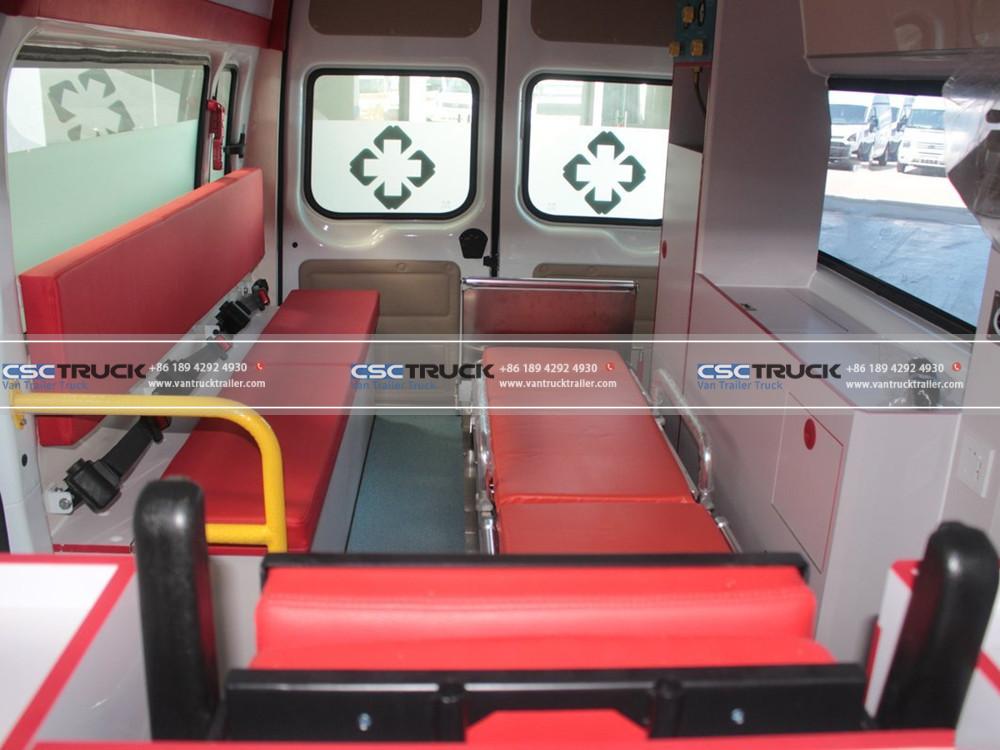
Redefining Mobile Intensive Care in Compact Platforms
The evolution of van-based critical care units represents a paradigm shift in advanced life support delivery, transforming standard ambulance chassis into sophisticated mobile ICUs capable of managing ECMO, intra-aortic balloon pumps, and multiple vasoactive drips en route. Where traditional Type I/III ambulances require 168-square-foot footprints for equivalent capabilities, modern Mercedes Sprinter and Ford Transit platforms achieve comprehensive critical care functions within 98 square feet through vertical treatment zones and retractable equipment arrays. Toronto EMS demonstrated this during a complex neonatal-pediatric transfer involving simultaneous high-frequency oscillatory ventilation and nitric oxide administration, where the van’s integrated ceiling rails enabled secure mounting of four life-support devices above the incubator without compromising clinician access – a configuration impossible in bulkier units. This spatial efficiency proves vital when navigating urban alleys or reaching remote accident sites inaccessible to larger rigs, ensuring tertiary care begins at the point of injury rather than hours later at the hospital doorstep.
Chassis Integration & Dynamic Stabilization
Achieving hospital-grade intervention fidelity on moving platforms demands revolutionary engineering:
Suspension Calibration Science
- Active hydraulic leveling counters centrifugal forces during turns, maintaining <3° gurney tilt at 0.8G cornering
- Predictive road scanning adjusts damping 200ms before encountering potholes using LiDAR terrain mapping
- Resonance frequency dampeners isolate the patient compartment from chassis vibrations below 15Hz
Structural Reinforcement Protocols
Van bodies undergo aluminum exoskeleton reinforcement at stress concentration points, while composite floor sandwiches with honeycomb cores withstand 12,000N point loads from helicopter lift systems. These modifications enable safe transport of 550lb bariatric patients with LVADs – a capability previously exclusive to mobile ICU trucks.
Critical Care Module Architectures
Interchangeable clinical pods transform vans for specialized missions:
Cardiothoracic Intervention Suite
- Motorized boom arms position fluoroscopy C-arms without compromising crash safety
- Pump-agnostic mounting docks secure IABP/ECMO units with automated level calibration
- Arrhythmia workstations with pull-out procedure trays for emergent pacing
Neuro-Trauma Configuration
- ICP monitoring bridges maintain transducer alignment during movement
- Retractable head immobilization systems with integrated cervical traction
- Hypothermia induction panels delivering cold saline through ceiling-mounted IV warmers
Melbourne’s MICA units reduced stroke thrombolysis delays by 47% using van-mounted CT scanners with AI-assisted bleed detection.
Multimodal Monitoring Integration
Clinical surveillance transcends traditional telemetry through:
- Unified patient data dashboards aggregating 27 streams from disparate devices into AI-analyzed timelines
- Contactless hemodynamic sensing using millimeter-wave radar to detect concealed hemorrhage
- Predictive analytics engines forecasting septic shock 22 minutes before hypotensive onset
The RFID-tracked modules automatically configure monitor presets when specialized equipment connects, eliminating 12-minute setup delays during pediatric-to-adult transitions.
Thermal & Environmental Control Systems
Precision climate management ensures medication integrity and patient homeostasis:
- Zoned compartmentalization maintains neonatal isolettes at 36.5°C while preserving blood products at 4°C
- Pharmaceutical refrigeration units with ±0.3°C stability outperform hospital pharmacy standards
- HEPA filtration with UV-PCO destroys airborne pathogens while scrbbing ethylene oxide from sterilization
Oslo’s critical care vans maintain ISO Class 5 air quality during open-chest wound management through laminar flow ceilings – a standard previously achievable only in operating theaters.
Power-Load Management & Redundancy
Supporting 18kW medical device loads requires robust energy architectures:
Hybrid Power Systems
- Lithium-titanate batteries deliver 400A surge currents for defibrillation without voltage sag
- Auto-switching inverters transfer between shore power and generators in 8ms
- Priority load shedding protects life-support devices during generator failures
Fault-Tolerant Circuitry
- Isolated grounding grids prevent electromagnetic interference with sensitive equipment
- Triple-redundant busbars maintain power during cable damage
- Real-time impedance monitoring detects insulation degradation before failures
Houston’s ECMO transport vans now achieve 99.999% power availability through naval-derived ring-bus electrical architectures.
Operational Flexibility Across Response Scenarios
The modular van platform enables unprecedented mission adaptability:
- Disaster Response Mode: Swaps cardiac monitors for mass-casualty triage systems with RFID-tagged patient tracking
- Neonatal Configuration: Deploying servo-controlled incubators with integrated nitric oxide delivery
- Bio-Containment Setup: Converting to negative-pressure isolation within 14 minutes using snap-seal partitions
These engineering principles now permeate adjacent industries: Refrigerated truck operators adopt medical-grade temperature controllers to preserve transplant organs during transport. Cargo truck manufacturers integrate ambulance-derived vibration dampening for sensitive aerospace components. Even vantrucktrailer combos for mobile surgical units utilize the same power redundancy systems that keep van ambulance ECMO pumps running during highway transfers. This cross-pollination underscores how critical care ambulance innovations increasingly redefine reliability standards for all mobile applications where failure carries catastrophic consequences – proving that the most demanding engineering challenges breed solutions that elevate entire industries.