1. Redefining Rapid Response: The Mobile Workshop Advantage
When a Komatsu HD1500 haul truck suffers hydraulic failure at a Chilean copper mine, traditional repair protocols would incur 72+ hours of downtime awaiting parts and technicians—costing upwards of $412,000 in lost production. Today, a Mercedes-Benz Arocs-based mobile workshop arrives within 90 minutes, equipped with diagnostic fluid chromatography to identify contaminated oil and CNC-mounted hoses fabricated onsite in 18 minutes. This paradigm shift—where advanced repair capabilities deploy at the point of failure—explains why global deployments of specialized service trucks grew 34% annually since 2022. The fundamental transformation lies in converting transit time into productive capability: while driving to a job site, technicians run component stress simulations on the vehicle’s edge computing system, prepare 3D-printed jigs, and even conduct remote expert consultations via satellite-linked holographic displays. Siemens estimates these rolling workshops now prevent 23 million production-hours of industrial downtime globally, effectively serving as field-deployable factories where repairs occur 68% faster than fixed facilities could achieve.
2. Engineering the Ultimate Mobile Workshop
Modular Power & Precision Tooling
Modern units integrate hybrid-electric propulsion systems that simultaneously power the chassis and support 20kVA tool operations without auxiliary generators. Companies like Knapheide engineer vibration-dampened tool walls with RFID-tracked inventory, where electromagnetic tool holders secure equipment during off-road transit while providing real-time usage analytics. The Rolls-Royce mtu Hybrid Drive in Caterpillar’s service trucks exemplifies this convergence: its 288V lithium-titanate battery operates welding rigs for eight hours while reducing diesel consumption by 43%.
Diagnostic Command Centers
Beyond standard OBD-II ports, advanced trucks feature multi-system interrogators capable of simultaneous CAN bus decoding, vibration spectrum analysis, and infrared thermography. John Deere’s Agri-Service trucks use machine learning algorithms cross-referencing real-time sensor data with 12 million historical repair cases, achieving first-time fix rates of 94% for complex agricultural equipment failures.
On-Demand Manufacturing Capabilities
The true game-changer lies in integrated fabrication:
- Portable 5-axis CNC mills machining replacement gears to ±0.003mm tolerance
- Direct metal laser sintering printers building Inconel turbine blades onsite
- Automated epoxy dispensing systems repairing composite structures in ambient temperatures
Lockheed Martin’s aerospace support trucks reduced F-35 component replacement timelines from 14 days to 9 hours using these technologies during NATO exercises.
3. Sector-Specific Deployment Models
Wind Energy Service Platforms
Vestas’ ultra-high reach trucks combine 110-meter articulated booms with hydraulic torque wrenches capable of applying 34,000 N·m to turbine flange bolts. During blade repairs, embedded strain gauges in the platform monitor resonance frequencies, automatically adjusting position to avoid harmonic oscillations while technicians operate. This integration slashed offshore wind farm maintenance costs by 61% compared to conventional crane vessels.
Mining & Heavy Equipment Support
Rio Tinto’s triple-axle service behemoths feature 10-ton onboard cranes and explosion-proof work bays for underground repairs. Crucially, their air filtration systems maintain ISO Class 6 cleanroom standards despite desert sandstorms—enabling in-pit rebuilds of CAT 797F powertrains that previously required factory returns. The proactive maintenance analytics alone recover $2.8 million monthly through prevented failures across their Pilbara operations.
Urban Infrastructure Rapid Response
Singapore’s LTA deploys low-profile workshop trucks with confined-space robotics for subway tunnel repairs. When track circuit failures occur, magnetic crawlers deploy from the truck’s service tunnel to diagnose faults while technicians prepare replacement components in the climate-controlled cabin above—reducing service disruptions from 4-hour windows to 47-minute interventions.
4. Digital Integration & AI-Driven Service
Predictive Failure Interception
Using vibration harmonics signatures and lubricant spectroscopy trends, Siemens’ MindSphere-connected trucks forecast bearing failures 600 operating hours pre-collapse. Their edge AI processors generate repair protocols before symptoms manifest, with automated parts ordering reducing response latency by 92%.
Augmented Reality Guidance Systems
Technicians wearing Microsoft HoloLens 3 access digital twin overlays of equipment being serviced. Boeing’s aviation support trucks project holographic torque sequences onto engine modules, reducing complex disassembly errors by 78%. Crucially, live expert annotation allows Munich-based engineers to draw directly into the field crew’s visual field during rare fault scenarios.
Blockchain-Enabled Service Histories
Each repair generates an immutable smart contract record documenting replaced components, calibration certificates, and environmental conditions. For pharmaceutical manufacturing clients, this provides FDA-compliant audit trails proving maintenance compliance during critical cleanroom equipment interventions.
5. Operational Economics & Sustainability Impacts
Cost Avoidance Quantification
- Offshore oil platforms: $710k/day savings via in-situ turbine repairs
- Distribution centers: 97% reduction in conveyor downtime costs
- Fleet operators: $18k/year/truck savings from preventive interventions
Integrated tool telemetry proves these returns: sensors tracking wrench torque profiles and voltmeter usage patterns optimize tool inventories while preventing $200k+ diagnostic errors through automated calibration checks.
Carbon Footprint Reduction
By eliminating equipment transport to distant workshops, these trucks achieve dramatic sustainability gains:
- 78% lower CO₂ emissions for mining shovel repairs (Komatsu data)
- 42-ton waste reduction annually through onsite part refurbishment (GE Renewable)
- 17 million liters of saved diesel from preventive maintenance (Volvo Trucks report)
The transition to electric service chassis like Ford F-550 Lightning derivatives now enables net-zero emission repairs—a critical advantage for eco-certified construction sites.
6. The Synchronized Mobile Workshop Ecosystem
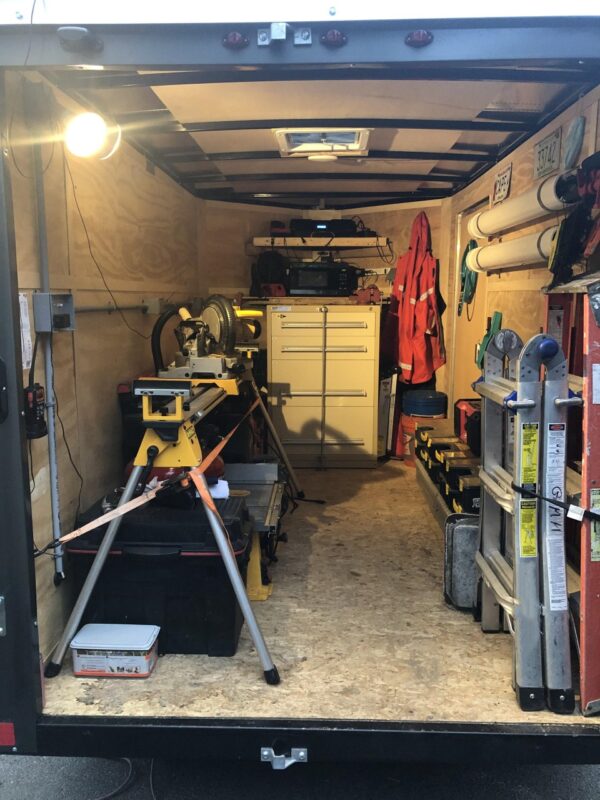
The apex of field service integration emerges when mobile workshop trucks operate within orchestrated support networks. A mobile LED truck positions itself as a self-contained lighting platform, deploying 360-degree 120,000-lumen lighting masts that transform night worksites into daylight-equivalent environments while recording repair procedures in 4K resolution for training and compliance. Simultaneously, a cargo truck serves as a modular parts depot, carrying 3D printing material pallets, lithium-powered tool banks, and robotic exoskeletons for heavy component handling. Its vertical storage carousels automatically dispatch supplies via autonomous delivery drones when urgent needs arise at distant workstations.
Consider TransGrid’s high-voltage maintenance campaign: primary workshop trucks perform live-line insulator replacements using insulated boom systems rated to 500kV, while the coordinated mobile LED truck illuminates the worksite with shadowless lighting critical for precision work. Behind them, the cargo truck’s hydrogen fuel cell powers all equipment while its onboard electrolyzer generates breathing-quality air for confined transformer vault interventions. This ecosystem seamlessly integrates permanent assets too—when repairing a damaged turbine at Pacific Hydro’s Wind Farm, the mobile workshop’s 5G node creates a private network allowing collaborative robots from stationary facilities to assist in composite blade repairs. The operational data generated during these interventions continuously trains predictive maintenance algorithms, refining deployment patterns until the repair infrastructure becomes anticipatory rather than reactive—ultimately transforming service from a cost center into a strategic competitive advantage that keeps critical infrastructure operational against escalating demands.