The Groundwork of Gravity
On any active construction site, mining operation, or highway project, the rhythmic roar of diesel engines signals a fundamental truth: dump trucks form the literal backbone of material movement. Yet the seemingly simple question—”how much can one carry?”—unfolds into a complex engineering equation where physics, regulations, and operational pragmatism intersect. Unlike a general cargo truck transporting uniform pallets, the dump truck’s capacity is a dynamic variable shaped by far more than just its bed dimensions.
1. Capacity Metrics: Volumetric Space vs. Weight Thresholds
Payload capacity exists in two distinct but interdependent dimensions – the physical space within the bed and the legal weight limits governing its movement.
Struck vs. Heaped Cubic Yards
- Struck Capacity: Measured flush with the top of the bed walls, representing the exact geometric volume without spillage—typically ranging from 10 cubic yards for a standard single-axle truck to 40+ cubic yards for large articulated models transporting lighter aggregates like topsoil or wood chips.
- Heaped Capacity: Accounts for material naturally forming a conical pile above the bed rails according to its angle of repose, adding 15-30% more volume depending on the material’s cohesiveness and loading technique.
Gross Vehicle Weight Rating (GVWR)
- Every dump truck operates within strict manufacturer-set GVWR limits (often 26,000 lbs to over 100,000 lbs), encompassing the empty vehicle weight (tare weight), fuel, driver, and payload.
- Exceeding this limit risks catastrophic structural failure, suspension damage, and braking inefficiency—making precise load calculation mandatory even when volumetric space remains available.
2. Classification & Scale: From Urban Utility to Mining Behemoths
Carrying capacity escalates dramatically across dump truck categories, each engineered for specific terrains and material densities.
Standard Rear-Dump Trucks
- Single Axle (6×4): Dominating municipal roadwork, capacities of 6-10 cubic yards (approx. 8-14 tons) balance urban maneuverability with adequate gravel hauling.
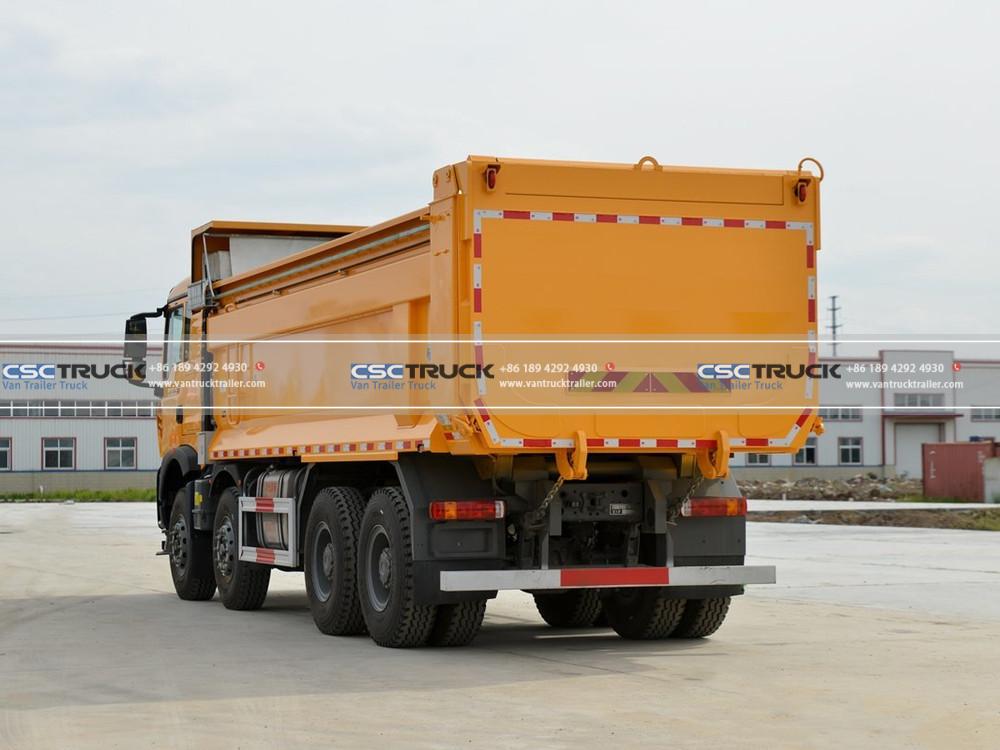
- Tandem Axle (8×4): Common for highway earthmoving, handling 14-20 cubic yards (approx. 20-30 tons) of excavated soil or crushed concrete within typical 52,000 lb GVWR.
Articulated Haulers (ADTs)
- Combining tractor-trailer flexibility with off-road resilience, these giants feature 30-45 cubic yard beds capable of moving 40-60 tons of iron ore or dense shot rock across unstable quarry floors.
Rigid Frame Off-Highway Trucks
- The titans of mining operations, exemplified by models like Caterpillar 797F or BelAZ 75710, possess 400+ cubic yard capacities and carry payloads exceeding 400 metric tons—equivalent to 40 tandem-axle trucks in a single cycle.
3. Material Density: The Invisible Payload Governor
Volumetric capacity becomes meaningless without accounting for material density—a load of crushed granite occupies the same space as mulch but exerts profoundly different weight forces.
Critical Density Variations
- Light Aggregates: Wood chips (400-600 lbs/cu yd), dry topsoil (1,100-1,400 lbs/cu yd). A 20-cu yd tandem dump truck could safely carry a heaped load without approaching GVWR.
- Medium Aggregates: River gravel (2,800-3,000 lbs/cu yd), asphalt millings (2,400 lbs/cu yd). Requires careful loading to avoid exceeding axle weight limits despite available space.
- Ultra-Dense Materials: Iron ore (5,500-6,000 lbs/cu yd), granite riprap (4,000-4,500 lbs/cu yd). Can max out GVWR with just 60-70% of volumetric capacity filled.
Practical Loading Strategies
- Operators utilize on-board weighing systems and pre-calculated load charts correlating bucket counts from excavators/loaders (e.g., 5 passes of a 4-cu yd bucket = ~20 cu yds at target density).
4. Engineering & Technology: Maximizing Payload Efficiency
Modern designs optimize structural strength while minimizing dead weight through advanced materials and intelligent systems.
Advanced Frame & Bed Design
- High-Strength Steel (HSS): Reduces tare weight by 15-20% versus traditional steel, directly increasing usable payload capacity within GVWR limits.
- Optimized Bed Geometry: Sloped sides and reinforced floors maximize structural integrity while facilitating rapid material ejection during dumping cycles.
Payload Management Systems
- Integrated Load Scales: Strain sensors on suspension components provide real-time weight display (<±3% accuracy), preventing accidental overloading.
- Telematics Data: Fleet managers monitor payload efficiency across routes, identifying underutilized trucks or chronic overloading risks before violations occur.
5. Regulatory & Operational Realities: Beyond Manufacturer Specs
Legal constraints and site conditions impose practical ceilings often lower than a truck’s theoretical maximum.
Federal Bridge Formula & Axle Limits
- U.S. federal law enforces strict axle weight distributions: 12,000 lbs on steer axles, 34,000 lbs on tandem drive axles, with total GVWR capped at 80,000 lbs for interstate highways. Even trucks rated higher operate under this limit on public roads.
- Permitted Overloads: Specialized haul routes may permit weights exceeding 100,000 lbs, but require complex permitting, escorts, and enhanced insurance—often negating cost benefits for routine loads.
Site-Specific Constraints
- Terrain & Gradient: Steep inclines or soft ground reduce safe operational weights well below highway GVWRs due to traction loss and rollover risks.
- Cycle Time Economics: Overloading may increase per-trip volume but causes excessive tire wear, suspension stress, and fuel consumption—optimal payload balances volume with long-term operating costs.
The Payload Equilibrium
Ultimately, a dump truck’s true carrying capacity resides at the intersection of its engineering limits, the physics of its cargo, and the legal frameworks governing its movement. While a cargo truck might prioritize cubic footage for uniform boxes, and a Vantrucktrailer optimizes for flexible freight configurations, the dump truck masters the art of dense, irregular bulk. Its genius lies not in carrying the absolute maximum, but the optimal load—delivering raw material economies by balancing volumetric space, gravitational force, and operational pragmatism in every cycle. From hauling 8 tons of asphalt patching material through city streets to shifting 400 tons of copper ore in an open-pit mine, this remains its defining purpose: transforming engineered capacity into tangible progress.