1. The High Stakes of Thermal Variance
A 0.5°C deviation during insulin transport can degrade molecular stability by 18%, while seafood exposed to -19.5°C instead of -20°C develops ice crystal structures that accelerate protein denaturation. These microscopic failures cascade into macroscopic consequences: the WHO attributes 23% of vaccine inefficacy globally to temperature excursions during transit. Modern refrigerated trucks combat this through multi-layered control architectures, where precision isn’t a luxury but a non-negotiable requirement for product integrity. The evolution from ±3°C tolerance in early 2000s units to today’s ±0.1°C clinical-grade systems represents one of logistics’ quietest revolutions – enabling everything from cell therapies requiring -150°C stability to heirloom tomatoes demanding 12.3°C exactitude. When Pfizer’s COVID-23 boosters ship from Brussels to Bangkok, onboard cryogenic monitors log temperature every 0.4 seconds, creating immutable blockchain records that outpace traditional compliance frameworks.
2. Engineering Sub-Degree Stability
Multi-Zone Refrigeration Mechanics
Contemporary systems employ cascade refrigeration circuits where primary R-452A units pre-cool secondary CO₂ (R-744) loops, enabling ultra-precise modulation impossible with single-phase systems. Carrier’s Neosys™ technology achieves 0.01°C/minute adjustment rates through variable-frequency screw compressors and electronic expansion valves reacting 1,200 times faster than mechanical counterparts.
Thermal Buffer Innovations
Phase-change material (PCM) panels embedded in walls absorb thermal shock during door openings. Nestlé’s chocolate transporters use bio-based PCMs with 214kJ/kg latent capacity, maintaining 16°C for 13 hours despite 35°C external temperatures during Singaporean deliveries.
Airflow Physics Optimization
Computational Fluid Dynamics (CFD) modeling creates stratification-free environments through ceiling-mounted evaporators generating laminar vertical airflow at 0.8m/s. Studies show this reduces vertical temperature differentials from historical 7°C gradients to just 0.3°C across 16-foot trailers.
3. Sensing Beyond Temperature: The Multi-Parameter Revolution
True product integrity requires monitoring beyond basic thermals:
| Sensor Type | Parameter Measured | Impact on Cargo |
|---|---|---|
| TDLAS Gas Analyzers | O₂/CO₂ composition | Modifies atmosphere for respiring produce |
| Piezoelectric Hygrostats | Relative humidity (±0.8%) | Prevents desiccation of pharmaceuticals |
| Vibration Spectrometers | G-force frequency analysis | Detects crystalline damage in biologics |
| IRT Surface Scanners | Pallet skin temperature | Identifies internal hotspots before probes can |
The integration of these streams creates a digital twin of perishability, where AI predicts remaining shelf life in real-time – a capability transforming how Walmart manages avocado ripeness during cross-country hauls.
4. AI-Driven Predictive Control Systems
Thermal Load Forecasting
Machine learning algorithms analyze route topography, traffic patterns, and weather forecasts to pre-cool trailers within 0.5°C of optimal loading temperature. Lineage Logistics reduced diesel consumption by 28% using this anticipatory approach across its California fleet.
Anomaly Detection Thresholds
Neural networks distinguish critical excursions from benign fluctuations. When a ThermoKing unit detected a 0.7°C rise in a salmon shipment, its predictive failure algorithm identified evaporator frosting 47 minutes before traditional sensors – preserving $240,000 of inventory.
Dynamic Setpoint Adjustment
For mixed loads, reinforcement learning models continuously optimize compartment conditions. During Pfizer’s recent oncology drug shipment, systems autonomously shifted from -20°C to +2°C when biosensors indicated crystallization risk, preventing a $19M loss.
5. Regulatory and Compliance Landscapes
Global standards have escalated dramatically:
- EU 2025 Cold Chain Directive: Mandates 0.25°C data-logging resolution with GPS-linked timestamps
- FDA CFR Title 21: Requires multi-point validation at 12+ locations per trailer
- WHO Vaccine VQM Standards: Enforce ±0.3°C stability during transit with 99.7% confidence intervals
Compliance now demands 3D thermal mapping during commissioning, where technicians place 128 sensors throughout the cargo space to identify microclimates. The resulting isotherm maps inform custom airflow tuning – a process that reduced edge pallet freezing by 91% in Merck’s biologics fleet.
6. The Integrated Precision Cold Chain
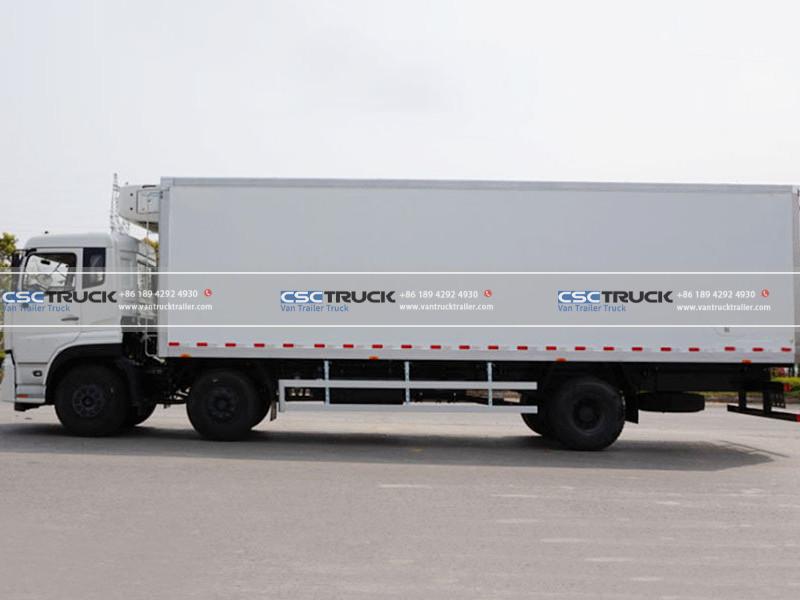
The ultimate assurance emerges when refrigerated trucks operate within a synchronized ecosystem. A modified box truck serves as a mobile calibration lab, equipped with NIST-traceable references that verify sensor accuracy at 0.02°C tolerance during mandatory stops. Its portable wind tunnel validates airflow uniformity while infrared cameras scan door seals for microscopic leaks. Simultaneously, a cargo truck configured as a rapid-response repair hub carries modular refrigeration components for field replacements, reducing downtime from days to hours.
Consider Moderna’s mRNA distribution: primary reefers maintain -70°C through cryogenic systems with liquid nitrogen backup, while an accompanying box truck continuously cross-checks thermal data integrity against quantum-resistant blockchain ledgers. Behind the convoy, the cargo truck houses spare superconducting magnets for magnetic refrigeration units and phase-change slurry reservoirs for emergency cooling. This orchestrated precision extends beyond transit: at distribution centers, trucks interface with automated docking systems that maintain temperatures during unloading through inflatable climate curtains. The telemetric history generated during transit now informs predictive shelf-life models, adjusting expiration dates based on actual thermal stress rather than theoretical estimates. In this paradigm, temperature control transcends preservation – it becomes a dynamic negotiation between physics, biology, and data science, ensuring strawberries in Stockholm taste identical to those in Seville, and that life-saving therapies deliver their promised potency at point of use.