
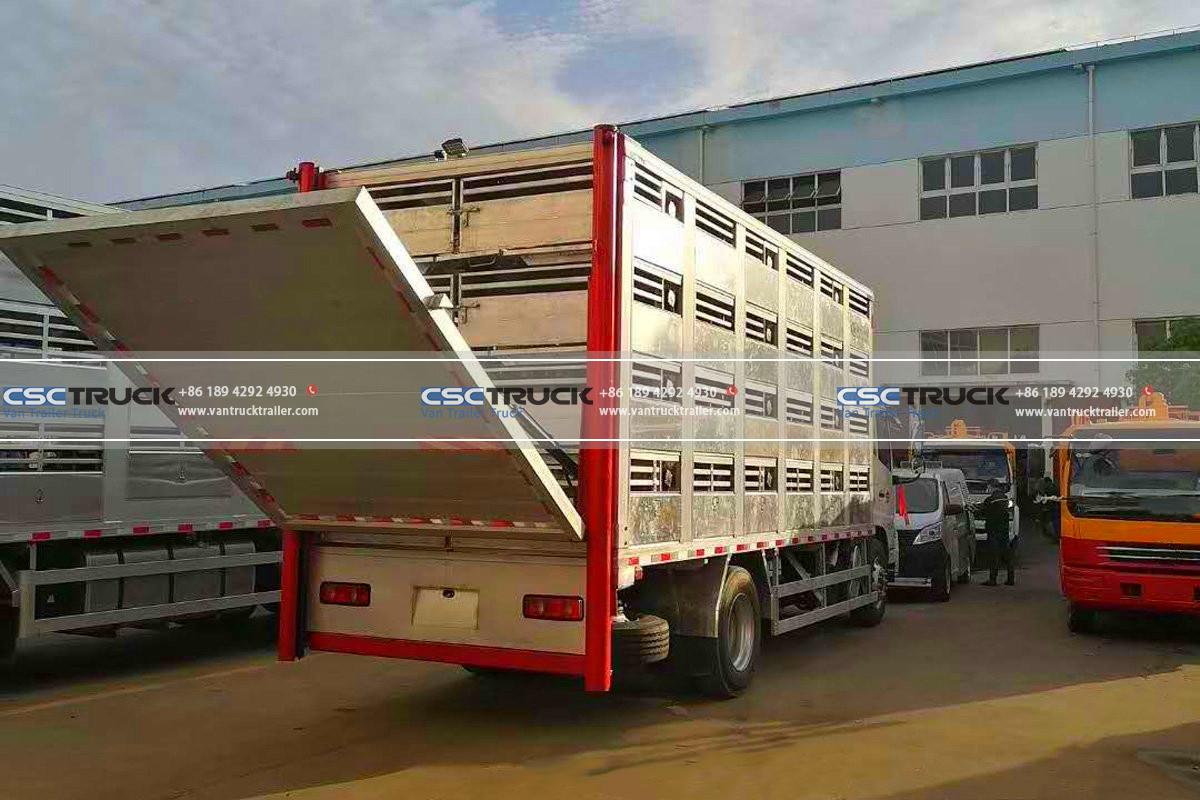
In a strategic enhancement of national food security infrastructure, Vantrucktrailer and Saudi conglomerate Najd Agricultural Development have delivered 84 advanced biosecurity livestock trucks to major farms across the Al-Ahsa, Qassim, and Najran regions.
Engineering Innovations for Disease Mitigation and Animal Welfare
The custom-designed livestock transporters incorporate seven integrated biosecurity systems validated by the World Organisation for Animal Health (WOAH). Each unit features positive-pressure air filtration with HEPA-14 filters removing 99.995% of airborne pathogens, while automated chemical spray tunnels disinfect vehicle exteriors and livestock hooves before loading. Crucially, the compartmentalized design segregates animals by health status using veterinary-grade barriers, preventing cross-contamination during multi-farm collection routes that often span 600km across desert terrain.
Thermal Management and Structural Integrity
The climate-controlled trailers maintain 4°C–28°C stability through sandstorm events – critical for reducing heat stress during summer transports where external temperatures exceed 50°C. Double-walled insulated compartments with radiant heat barriers lower cooling energy requirements by 40% compared to conventional models. Structural enhancements include corrosion-resistant alloys to withstand high-ammonia environments and non-porous polyurethane flooring with 15° drainage slopes that enable complete fluid evacuation, eliminating residual moisture where pathogens proliferate.
Remote Monitoring and Decontamination Systems
An IoT-enabled biosecurity telematics platform continuously tracks ammonia concentrations, animal core temperatures, and particulate levels, triggering automatic ventilation adjustments when thresholds are breached. The patented self-decontamination cycle engages upon unloading: UV-C ceiling arrays activate alongside electrostatic disinfectant misting, achieving 6-log pathogen reduction in 22 minutes without manual intervention – a 78% time improvement over traditional washdown protocols.
Supply Chain Integration and Broader Agricultural Impact
The 12-year technical service agreement includes AI-driven maintenance forecasting using real-time component health data from 380 embedded sensors per vehicle. This enables Najd Agricultural Development to maintain 99.3% fleet availability during critical Hajj season shipments when demand peaks at 1.2 million sheep and cattle movements monthly. The contract’s second phase will deploy 210 auxiliary vehicles by Q1 2026, including dry van truck configurations for certified feed transport and modified cargo truck units equipped with mobile veterinary laboratories to perform on-site blood testing before livestock loading.
The fleet’s deployment synchronizes with Saudi Arabia’s new Livestock Transit Compliance Regulations requiring real-time biosecurity data submission to the National Agriculture Development Center. Early operational data from pilot routes shows a 92% reduction in Salmonella detection at processing facilities and a 41% decrease in mortality rates during long-haul transports – metrics projected to save producers $28/head in condemnation losses. As regional integrators like Almarai Company adopt this model, the technology establishes a new benchmark for secure protein logistics across GCC markets facing escalating zoonotic disease threats.
Key Specifications Table
| Feature | Specification | Industry Impact |
|---|---|---|
| Pathogen Filtration | HEPA-14 + UV-C Decontamination | 99.995% airborne virus removal |
| Thermal Control | -15°C to +45°C operational range | 0% heat-related mortality in trials |
| Structural Materials | EN 1.4529 super austenitic stainless steel | 3x lifespan vs. standard carbon steel |
| Data Integration | Real-time WOAH-compliant reporting | Automated export certification |
| Water Efficiency | 86% less washdown water usage | 2.1M liters annual savings per vehicle |