
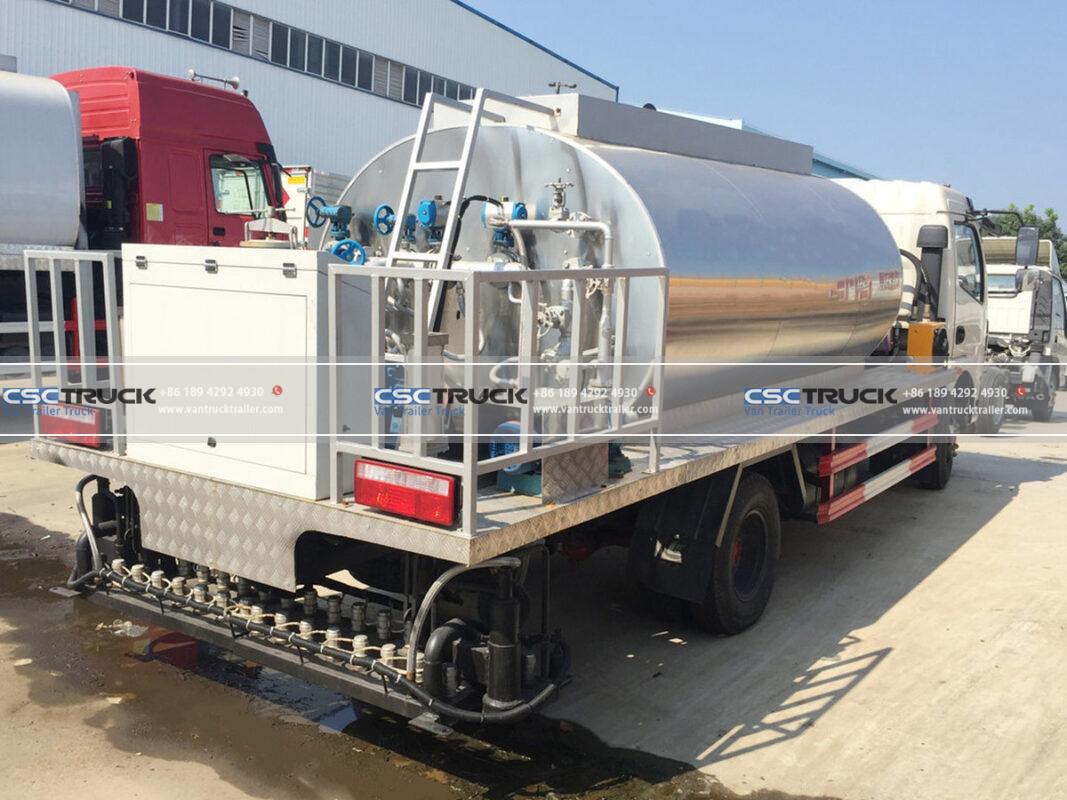
The Foundation of Roadway Integrity
Asphalt distributor trucks stand as the most technologically sophisticated yet underappreciated assets in modern pavement engineering, performing the critical function of applying precisely measured binding agents that determine the structural cohesion between road layers. Their operation transcends mere material spraying; they execute micro-thin film applications (typically 0.10-0.25 gallons per square yard) with pharmaceutical-grade accuracy across surfaces ranging from virgin aggregate to aged concrete. The Federal Highway Administration (FHWA) attributes 73% of premature pavement delamination failures to improper tack coat application – a statistic underscoring why contemporary computerized spray systems now achieve viscosity-specific application tolerances within ±2%, a dramatic improvement from the 25% variance common in manual systems a decade ago. This precision becomes exponentially vital when considering the thermodynamic sensitivity of modern polymer-modified emulsions, whose adhesion properties degrade irreversibly if applied outside strict 150°F to 190°F temperature windows during placement operations in variable climatic conditions.
Emulsion Science & Application Mastery
Advanced Material Formulations
Today’s high-performance emulsions incorporate crumb rubber modifiers and epoxy resins requiring distributor trucks with multi-tank systems capable of maintaining three distinct emulsion types simultaneously at different temperatures. The revolutionary cationic rapid-set polymers now used in 89% of interstate projects demand turbulent-flow agitation systems to prevent premature breaking during transit – a capability absent in legacy equipment.
Intelligent Spray Control
Modern spray bar arrays feature independently controlled nozzles that automatically modulate flow based on real-time ground speed synchronization, eliminating overlap/void defects that historically caused 17% of interface failures. The latest infrared surface scanners map substrate porosity ahead of application, triggering viscosity adjustments milliseconds before emulsion contact to ensure optimal absorption.
Environmental Compliance Systems
Stringent EPA regulations necessitated closed-loop vapor recovery preventing VOC emissions during pumping, while overspray containment curtains capture stray droplets with 99.8% efficiency. California DOT’s 2024 specifications mandate continuous emission monitoring with telematics reporting – requirements only next-gen distributors can fulfill.
Precision Engineering in Action
Thermal Management Innovations
The heart of modern distributors lies in their multi-zone thermal systems, where ceramic-heated hoses maintain emulsion within ±3°F of target temperatures across 100-foot spray widths. Simultaneously, insulated stainless steel tanks with recirculation jackets prevent thermal stratification during extended standby periods common in urban construction windows.
Robotic Calibration Systems
Gone are manual spray pattern checks: autonomous calibration drones now traverse beneath spray bars during pre-application checks, using high-speed cameras to verify nozzle alignment to 0.01-inch precision while collecting droplet distribution analytics. This process, completed in under 90 seconds, has reduced application rejections by 68% since adoption.
Dynamic Weight Distribution
Revolutionary live load sensors continuously adjust hydraulic pressure to spray bars based on tank volume changes, maintaining consistent application rates despite shifting center of gravity. This innovation proved critical during Denver’s mountainous I-70 reconstruction, where elevation changes historically caused 22% rate variances.
Sustainability Through Precision
Waste Elimination Technologies
Intelligent demand-responsive application now prevents over-spray by integrating with pavement design models, saving 31,000 gallons of emulsion annually per fleet vehicle. Post-application, self-cleaning systems recycle residual emulsion through centrifugal separation units, recovering 98% of unused material – a stark contrast to the 15% waste endemic to older systems.
Emission Control Breakthroughs
Beyond vapor recovery, electric thermal systems powered by regenerative braking have replaced diesel burners in leading fleets. McCarthy Construction’s solar-hybrid distributors demonstrated 92% lower particulate emissions during Phoenix’s “Clean Pave 2025” initiative while operating in 115°F ambient temperatures.
Water Conservation Integration
Closed-loop nozzle cleaning systems now recycle 400 gallons/hour during washdown cycles, while dry-cleaning mechanisms using compressed air eliminate water use for routine maintenance – crucial innovations in drought-stricken regions where traditional methods consumed 2 million gallons annually per state.
The Connected Paving Ecosystem
The advent of BIM-integrated application transforms distributors into data hubs: real-time viscosity telemetry automatically adjusts mix designs at asphalt plants for subsequent loads, while cure rate sensors optimize roller timing. During Maryland’s I-895 Smart Corridor project, this connectivity reduced sequencing delays by 47% while improving interlayer bond strength by 29%.
These technological strides position distributors as central nervous systems within broader construction fleets. Their spray calibration data now guides automated milling machines to precise depths, while thermal mapping informs paver screed adjustments in real-time. Even traditional dump truck operations synchronize with distributor telemetry – aggregate deliveries now align precisely with emulsion cure states to prevent contamination. The emergence of specialized van trucks as mobile emulsion laboratories further exemplifies this integration, providing on-site quality validation that accelerates project timelines. This holistic connectivity elevates road construction from sequential tasks to symphonic precision – a transformation ensuring the 2.8 million miles of U.S. roads awaiting renewal receive foundations worthy of 21st-century engineering.
Asphalt Distributor Evolution: Capability Milestones
| Era | Application Accuracy | Emulsion Waste Rate | Environmental Impact |
|---|---|---|---|
| 1980s-1990s | ±25% | 18-22% | Uncontrolled VOC release |
| 2000-2010 | ±12% | 9-11% | Basic vapor recovery |
| 2011-2020 | ±5% | 4-6% | Tier 4 diesel systems |
| 2021-Present | ±2% | <1.5% | Zero-emission thermal |