1. Global Frameworks and Foundational Regulations
Medical waste transport operates within a complex web of international and national standards designed to prevent biological hazards and environmental contamination. The Basel Convention on Hazardous Waste establishes cross-border shipment protocols, requiring “prior informed consent” documentation for infectious waste exports. Domestically, the EPA’s Resource Conservation and Recovery Act (RCRA) mandates cradle-to-grave tracking for hazardous pharmaceutical waste in the U.S., while the EU’s Waste Framework Directive 2008/98/EC classifies medical waste as “absolute hazardous.” These frameworks compel transporters to obtain biennial permits demonstrating adherence to route planning, spill containment, and emergency response standards.
2. Personnel Certification and Training Mandates
Transport crews require specialized credentials beyond standard driver’s licenses:
- OSHA Bloodborne Pathogens Certification: Annual 8-hour training covering exposure control plans and PPE protocols.
- DOT Hazardous Materials Endorsement (HME): Includes background checks and knowledge tests on UN3291 labeling requirements.
- Biohazard Handling Licenses: State-specific programs like California’s Medical Waste Management Act (MWMA) Certification, requiring 16 hours of instruction.
Operators must maintain training logs with refresher courses every 3 years to address evolving threats like antiviral-resistant pathogens.
3. Vehicle and Container Compliance
Regulatory bodies scrutinize transport hardware through unannounced audits:
3.1. Vehicle Specifications
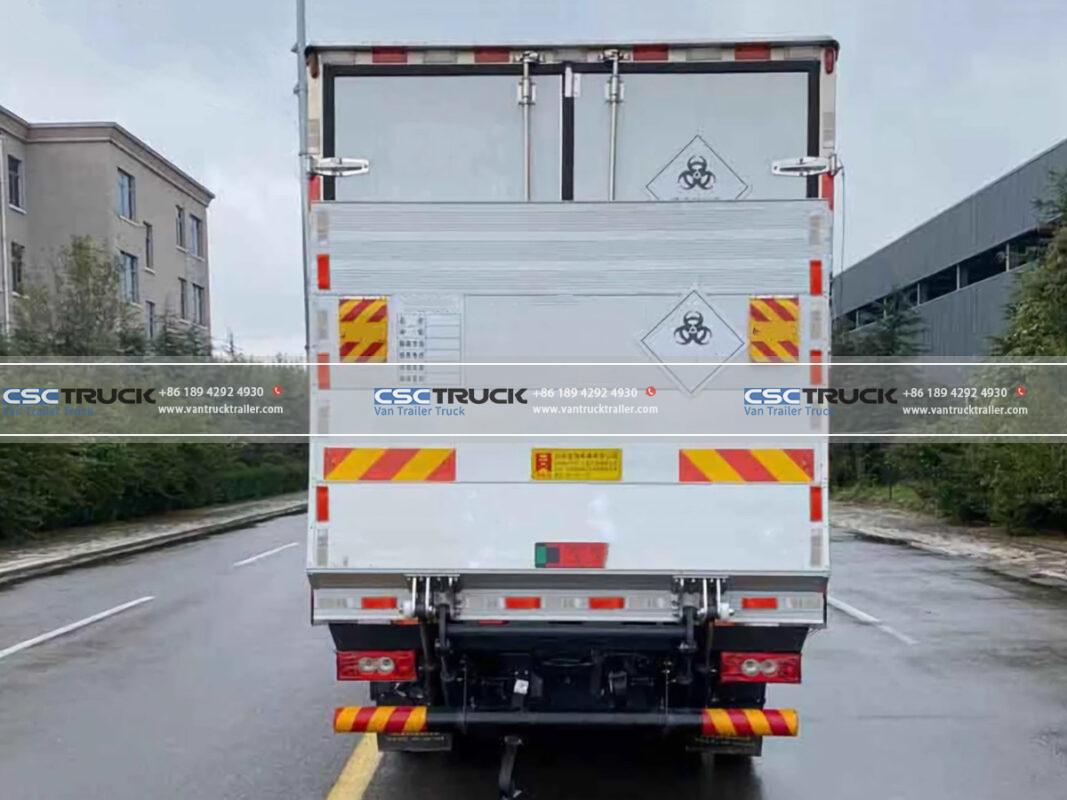
Trucks require fluid-tight secondary containment systems, GPS tracking, and compartmentalization separating sharps from chemical waste. The UNECE R107 certification governs structural integrity for vehicles in 56 signatory countries, mandating rollover testing and corrosion-resistant materials.
3.2. Container Standards
Containers must carry dual certifications:
- UN 3291 Certification for integrity during compression/temperature fluctuations
- ISO 23907-1:2025 Sharps Containers validation for puncture resistance
4. Documentation and Chain-of-Custody Protocols
Electronic manifests supersede paper trails under 2025 regulations, integrating:
- Real-time TempLoggers for refrigerated waste (e.g., vaccines)
- Blockchain-enabled custody tags meeting FDA’s DSCSA traceability requirements
- Waste Minimization Certificates proving compliance with circular economy targets
Penalties for manifest discrepancies now reach $76,000 per incident under revised EPA enforcement guidelines.
5. Regional Variations in Compliance
5.1. Asia-Pacific Rigor
China’s 2025 Medical Waste Reform requires provincial-level licensing and AI-powered route optimization systems. Pilot programs in Shanghai now mandate hydrogen peroxide sterilization of transport compartments after each shift.
5.2. EU’s Circularity Focus
Revised Waste Shipment Regulation (2024/0245) prioritizes reusable transport systems. Germany’s KrWG certification now deducts points for single-use container usage exceeding 15% of total volume6.
6. Emerging Standards and Future Preparedness
Three evolving certifications will reshape the sector by 2026:
- ISO/PAS 45005:2026 Biohazard Transport Resilience requiring climate-adaptation plans for flood/fire scenarios
- Carbon Neutral Transport Credentials aligning with COP30 emissions targets
- Autonomous Vehicle Permits for AI-driven waste convoys currently piloted in Arizona and Bavaria
Facilities should audit transporters’ digital twin compliance systems, which simulate regulation changes using AI predictive analytics. Regulatory bodies now view proactive certification upgrades as mitigation factors during violation investigations.