The Rise of On-Demand Industrial Capabilities
In an era where operational agility defines competitive advantage, industrial mobile workshops have emerged as game-changers across mining, energy, construction, and disaster response sectors. These self-contained units bring advanced repair, fabrication, and diagnostic capabilities directly to remote or time-sensitive job sites, eliminating costly equipment downtime and logistical bottlenecks. Unlike static facilities, they integrate power generation, climate control, specialized tooling, and digital infrastructure into a single mobile platform—transforming a standard truck or trailer into a high-tech industrial hub. The global market for these solutions is projected to exceed $4.7 billion by 2028, driven by demands for rapid deployment and resource efficiency.
Core Component 1: The Vehicle Platform – Beyond Transportation
Heavy-Duty Chassis and Customization
The foundation of any mobile workshop is its vehicle platform, engineered for extreme durability and payload capacity. Three dominant configurations exist:
- Modified Heavy-Duty Trucks (e.g., Freightliner, Volvo): Reinforced frames support up to 25-ton loads, with all-wheel-drive options for off-road oil fields or mining sites.
- Expandable Trailers: Hydraulic sidewalls increase floor space by 40%, enabling full-scale machining or welding bays.
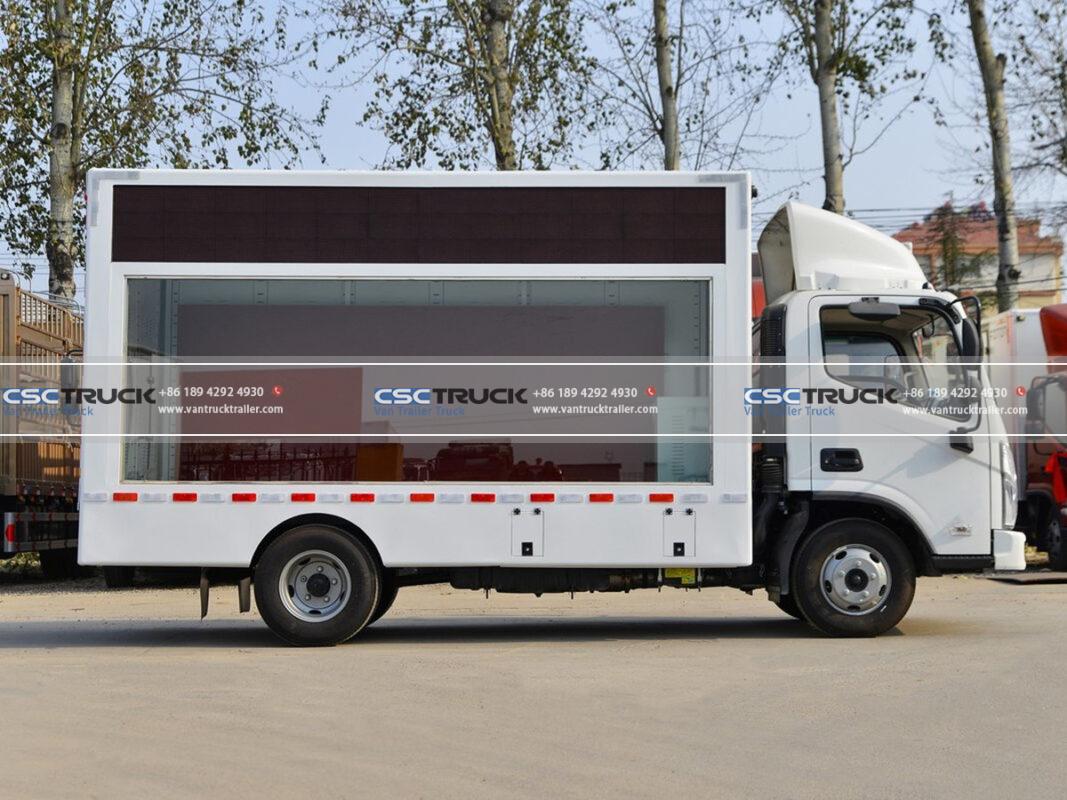
- Hybrid Van Solutions: Compact units like the professional mobile LED truck integrate lighting rigs and fold-out workbenches for emergency electrical repairs.
Critical enhancements include air-ride suspensions for vibration-sensitive calibration equipment, corrosion-resistant exteriors for coastal operations, and ISO-compliant mounting systems for interchangeable modules.
Climate and Environmental Control
Maintaining consistent temperatures (-20°C to +50°C) is non-negotiable for sensitive electronics or chemical processes. Solutions combine:
- HVAC Systems: Redundant 24V DC units with HEPA filtration to exclude dust in desert operations.
- Explosion-Proof Ventilation: Mandatory for workshops handling fuels or volatile compounds.
- Acoustic Damping: Noise reduction to 68 dB ensures OSHA compliance during prolonged use.
Core Component 2: Power Systems – The Uninterrupted Lifeline
Primary Generation and Redundancy
Mobile workshops demand resilient power architectures capable of running CNC mills, 3D printers, or diagnostic servers for 12+ hours. Tiered approaches include:
- Diesel Generators (20–150 kVA): Mainstay for high-amperage tools, often with soundproof enclosures.
- Lithium-Ion Battery Banks: Silent operation for night missions, recharged via solar panels or regenerative braking.
- Grid-Tie Hybrid Systems: Shore power compatibility cuts fuel use by 80% at depot-adjacent sites.
Advanced units feature automatic failover between sources, ensuring zero disruption during surgical procedures in mobile medical workshops.
Power Management Intelligence
Smart distribution panels monitor load balance, preventing overloads when simultaneous welding (30 kW) and air compression (15 kW) occur. IoT-enabled systems provide remote usage analytics, predicting generator maintenance before failures.
Core Component 3: Workshop Equipment – Industrial-Grade Versatility
Machining and Fabrication Suites
These transform trailers into machine shops:
- CNC Mills/Lathes: Bolt-mounted to vibration-dampened floors for micron-level precision.
- Portable Forges: Induction heating for on-site metal forming.
- Robotic Weld Arms: Mounted on radial booms for pipeline repairs in confined spaces.
Diagnostic and IT Infrastructure
- Vehicle CANbus Interfaces: Decode fault codes for mining trucks or wind turbine hydraulics.
- Portable CMMs (Coordinate Measuring Machines): Laser-scan turbine blades for erosion damage.
- 5G Mesh Networks: Enable AR-assisted repairs—technicians access schematics via HoloLens while hands-free.
Core Component 4: Safety and Compliance Ecosystems
Hazard Mitigation
- Intrinsic Safety (IS) Barriers: Isolate sparks in electrical panels near fuel vapors.
- Ergonomic Lockout/Tagout Stations: Secure energy sources during maintenance.
- Chemical Storage: UN-certified cabinets with spill containment sumps.
Regulatory Integration
Workshops adhere to:
- ISO 21815 (Mobile Workshop Design)
- NFPA 70E (Electrical Safety)
- Region-Specific Emissions Standards (Euro VI/EPA Tier 4)
Specialized Variants: Industry-Specific Innovations
The Mobile Stage Truck: Event Infrastructure Meets Industry
Originally for concerts, the mobile stage truck now serves as a command hub for refinery turnarounds. Its 360° access decks, integrated lighting, and PA systems coordinate hundreds of technicians during plant shutdowns. Hydraulic leveling stabilizers enable setup on uneven terrain in under 20 minutes.
Field Medical Units: Where Precision Meets Portability
Surgical trailers incorporate:
- Laminar Flow Ventilation: ISO Class 5 air purity for joint replacement surgeries.
- Telemedicine Suites: Real-time collaboration with hospital specialists.
- Pharmacy Dispensing Robots: Error-free medication management.
The Future: Autonomy and AI Integration
Emerging trends include:
- Predictive Maintenance AI: Analyzing engine sounds or thermal images to forecast failures.
- Autonomous Convoys: Self-driving workshops following crew buses to mining sites.
- Modular Swapping: Hot-swapping a welding module for a DNA lab in pandemic response units.
CSCTRUCK: Pioneering Modular Mobility
Leading this evolution is CSCTRUCK, whose Vantrucktrailer platform exemplifies scalability. Its patent-pending “plug-and-work” rail system allows rapid reconfiguration between a machine shop, mobile command center, or professional mobile LED truck for nighttime operations. With triple-axle stability, 30% weight reduction via composite materials, and compliance with global road regulations, the Vantrucktrailer is redefining rapid-response industrial capability—proving that the most critical factory floor might just be on wheels.