
Introduction: The Unseen Lifeline
Imagine biting into fresh mid-summer strawberries in the dead of winter, receiving life-saving vaccines in a remote clinic, or ensuring a perfect wedding bouquet arrives pristine. None of these modern miracles would be possible without a critical, often overlooked, piece of logistics technology: the refrigerated truck. Far more than just a cold box on wheels, these specialized vehicles are the indispensable arteries of the cold chain, a meticulously managed system preserving temperature-sensitive goods from producer to consumer. They represent a triumph of engineering and logistics, silently ensuring the safety, quality, and availability of countless products we rely on daily. This blog delves deep into the multifaceted world of refrigerated transport, exploring its vital applications and indispensable nature in our interconnected world.
1. Understanding the Cold Chain: The Foundation
At its core, the cold chain is an uninterrupted series of storage and distribution activities that maintain a product within a specified, controlled temperature range from the point of origin (like a farm, fishery, or pharmaceutical plant) to the point of final consumption or use. It’s a complex, vulnerable ecosystem where any break – a refrigeration failure, a delayed delivery, inadequate packaging – can lead to spoilage, financial loss, and potentially serious health risks.
Refrigerated trucks, often referred to as reefers, are the dynamic, mobile component of this chain. While cold storage warehouses provide static temperature control, reefer trucks provide the critical link that moves goods between these fixed points – from packing houses to distribution centers, from airports to supermarkets, from ports to hospitals – without ever letting the temperature fluctuate beyond strict tolerances. Their ability to maintain precise climates, whether deep freezing, chilling, or even providing heated transport in some configurations, is fundamental to the chain’s integrity.
2. The Primary Mission: Safeguarding Our Food Supply
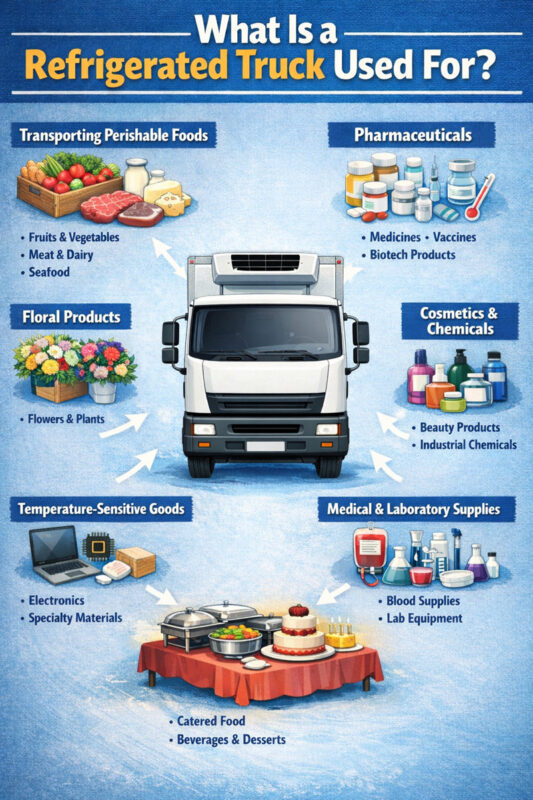
The most visible and extensive use of refrigerated trucks is undoubtedly within the food and beverage industry. They are the backbone ensuring that perishable items reach our tables safely, fresh, and nutritious. This role encompasses several critical sub-functions:
- Perishable Produce & Dairy: From crisp lettuce and ripe berries to gallons of milk and blocks of cheese, maintaining the “cold chain” is paramount. Reefer trucks slow down the natural processes of ripening, decay, and bacterial growth. Without them, the global, year-round availability of fresh fruits, vegetables, and dairy products we enjoy simply wouldn’t exist. They enable strawberries from California to grace shelves in New York in winter and New Zealand lamb to be served in London restaurants.
- Meat, Poultry & Seafood: The requirements here are even stricter, often demanding deep freezing or very specific chilling temperatures to prevent the growth of dangerous pathogens and preserve texture and flavor. Refrigerated transport is non-negotiable for ensuring meat arrives safely at processing plants, distributors, retailers, and ultimately, consumers. Seafood, highly susceptible to spoilage, relies entirely on reefers from the moment it’s caught or harvested.
- Prepared & Frozen Foods: The booming market for ready meals, frozen pizzas, ice cream, and other convenience foods is entirely dependent on temperature-controlled logistics. Reefers ensure these products remain frozen solid or properly chilled during transit, preserving taste, texture, and safety until they reach the consumer’s freezer or oven.
3. Beyond Sustenance: Protecting Health and Life – Pharmaceuticals & Healthcare
Perhaps even more critical than food transport is the role of refrigerated trucks in the healthcare sector, where the stakes involve human lives directly. This application demands extreme precision and reliability:
- Vaccines & Biologics: Many life-saving vaccines, insulin, blood products, cell therapies, and other biologics are extremely temperature-sensitive. Deviations of just a few degrees can render them ineffective or even dangerous. Pharmaceutical-grade reefers feature sophisticated monitoring systems, backup power, and ultra-precise temperature control (often within a +/- 1°C or even tighter range) to ensure these vital medical products remain potent and safe throughout their journey from manufacturing facility to clinic, hospital, or pharmacy. This segment represents some of the highest-value and most regulated cargo moved by reefers.
- Medical Samples & Diagnostics: Transporting blood samples, tissue cultures, diagnostic reagents, and other medical specimens often requires strict temperature control to preserve their integrity for accurate testing and diagnosis. Reefers provide the necessary environment for this crucial link in healthcare diagnostics.
- Specialty Medical Supplies: Certain medical devices, implants, and laboratory chemicals also require temperature-controlled transport to maintain sterility or chemical stability.
4. Floral Freshness: Preserving Beauty and Fragility
The vibrant blooms that adorn weddings, events, and homes often travel vast distances. Cut flowers are incredibly perishable, wilting rapidly if exposed to heat or ethylene gas. Refrigerated transport is essential for the floral industry. Reefers maintain low temperatures and high humidity levels, significantly slowing the flowers’ respiration and aging process. This allows delicate orchids from Thailand, roses from Ecuador, or tulips from the Netherlands to arrive at florists worldwide looking fresh and vibrant, extending their vase life for the end consumer. It’s a niche but vital application where precise climate control directly translates to product value and consumer satisfaction.
5. Industrial & Specialized Applications: The Unexpected Cold
The need for temperature-controlled transport extends beyond consumables into surprising industrial and specialized sectors:
- Chemicals & Regulated Goods: Certain chemicals, adhesives, photographic film, specialty electronics components, and even some types of artwork or museum artifacts require strict temperature or humidity control during transit to maintain their properties, stability, or prevent degradation. Refrigerated trucks provide the necessary stable environment.
- High-Tech & Temperature-Sensitive Manufacturing: Components used in aerospace, semiconductor manufacturing, or other high-precision industries might require transport in tightly controlled conditions to prevent thermal expansion, condensation, or other damage that could affect their performance in final assemblies.
- Event & Catering Logistics: Large-scale events, from concerts to corporate gatherings, rely on reefers to transport and store perishable food and beverages safely on-site before and during the event, ensuring food safety for thousands of guests.
6. How It Works: The Tech Behind the Chill
Understanding the why necessitates a glimpse into the how. A modern refrigerated truck is a complex system:
- The Insulated Shell: The foundation is a highly insulated cargo box, typically constructed from panels with polyurethane foam cores, acting like a giant thermos to minimize heat transfer.
- The Refrigeration Unit: Mounted on the front wall (or sometimes underneath), this is the heart of the system. It operates much like a household fridge but on a massive, robust scale designed for demanding transport conditions. It consists of a compressor, condenser, expansion valve, and evaporator, circulating refrigerant to absorb heat from inside the cargo box and expel it outside. Modern units are incredibly sophisticated, capable of maintaining temperatures from deep freeze (-30°C/-22°F or lower) to mild chilling (+10°C/50°F) with remarkable precision.
- Power Source: The unit typically runs off the truck’s engine (via a power take-off or dedicated diesel engine/generator) while driving, and often switches to an external electrical hook-up or an auxiliary power unit (APU) when parked to prevent idling the main engine.
- Control & Monitoring: Advanced digital controllers allow drivers and fleet managers to set and monitor the exact temperature. Modern systems provide real-time telematics, sending temperature data, location, and unit status to dispatchers and customers, enabling proactive intervention if issues arise. Data loggers often provide an auditable trail crucial for compliance, especially in pharmaceuticals and high-value foods.
- Airflow Management: Properly designed and maintained airflow within the cargo space is essential. Goods must be loaded to allow cold air to circulate freely around them, preventing warm spots that could lead to spoilage. Blocked evaporator units are a common cause of temperature excursions.
7. Moving Forward: Indispensable Infrastructure
The importance of refrigerated transport continues to grow exponentially. Rising global populations, increasing urbanization stretching supply chains, consumer demand for fresh and exotic foods year-round, the globalization of pharmaceutical production, and heightened awareness of food safety and waste all drive reliance on efficient and reliable cold chain logistics. Innovations in refrigeration technology focus on improving energy efficiency (reducing fuel consumption and emissions), integrating alternative power sources like electric standby or even full electric drive systems, enhancing telematics for better visibility and predictive maintenance, and developing more sustainable refrigerants.
While specialized equipment like a dump truck is designed for moving loose materials like gravel or sand, or a standard van truck focuses on dry freight, the refrigerated truck occupies a unique and critical niche. It’s not merely about transporting goods; it’s about preserving life, health, quality, and economic value under exacting environmental conditions. From the compact urban delivery vantrucktrailer to the massive long-haul semi-trailer reefer, these temperature-controlled workhorses are truly the silent guardians of our modern way of life, ensuring the safe passage of essentials that depend on the cold. Their constant hum on the highways is the sound of a fragile, vital chain holding firm.