
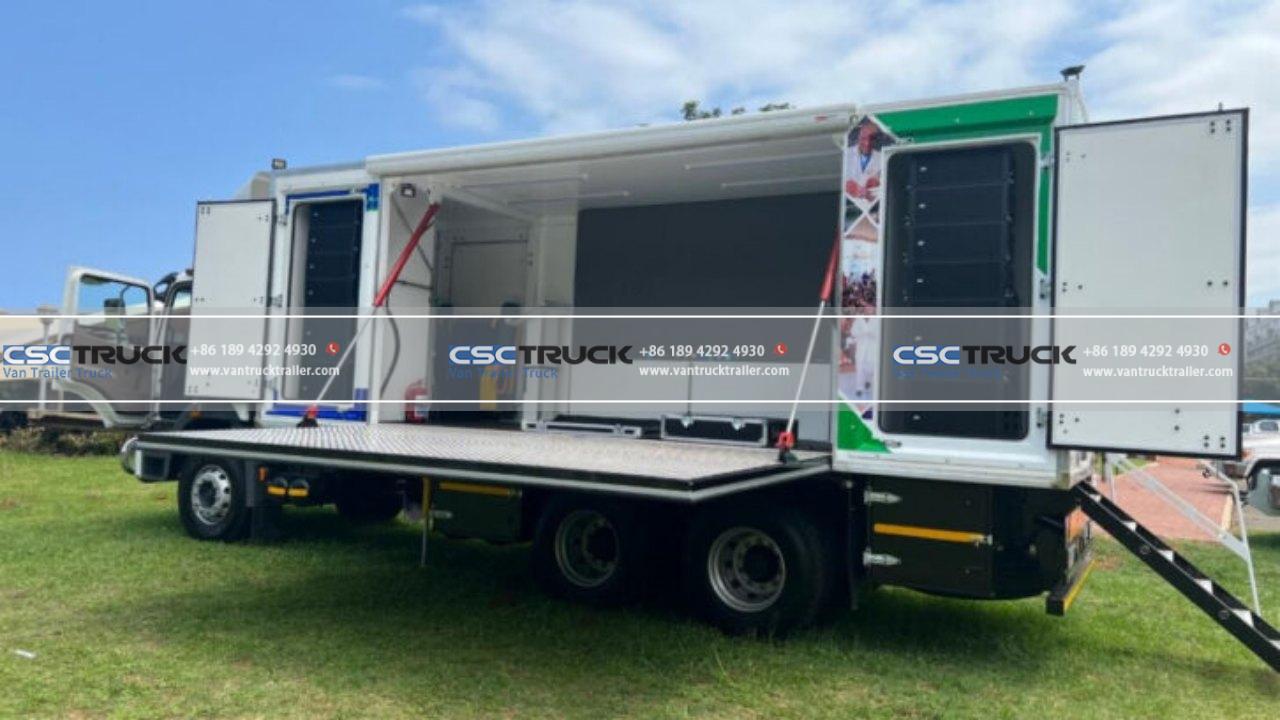
The spectacle unfolds effortlessly: a hydraulic stage rises in minutes, LED walls ignite with crystal visuals, and concert-grade audio envelops the crowd. Yet behind this seamless performance lies an engineering marvel often overlooked—the sophisticated power architecture enabling mobile stage trucks to transform any site into a professional venue. Unlike fixed installations tethered to grid infrastructure, these self-contained production hubs demand robust, adaptable energy solutions capable of sustaining high-wattage loads through dust storms, torrential rain, or remote desert locations. The choice of power source transcends mere electricity generation; it dictates operational flexibility, environmental impact, budget viability, and ultimately, show reliability.
The Diesel Workhorse: Conventional Generators Reimagined
For decades, industrial diesel generators have anchored mobile event power. Modern units, however, bear little resemblance to their noisy, inefficient predecessors. Today’s trailer-mounted systems integrate:
- Tier 4 Final Engines: Utilizing advanced exhaust after-treatment (SCR/DEF) to reduce particulate matter by 90% and NOx emissions by 50% versus older models, meeting stringent EPA standards without sacrificing torque.
- Variable Speed Technology: Dynamically adjusting RPMs based on load demand—crucially dropping to 1,200 RPM during 30% load scenarios—slashing fuel consumption by 25-40% and noise to 65 dBA at 10 meters.
- Parallel Operation Capability: Synchronizing multiple 200-400 kVA generators via digital load management systems, enabling scalable power from 50 kW intimate gatherings to 1.5 MW festival main stages without manual reconfiguration.
This evolution ensures diesel remains indispensable for sustained high-amperage draws—particularly when powering 40,000-lumen laser projectors or subwoofer arrays exceeding 15 kW.
Silent Revolution: Lithium-Ion Battery Arrays
The rise of lithium-iron phosphate (LiFePO4) technology has unlocked emission-free operation for sensitive environments—historic districts, indoor expos, or noise-restricted residential zones. Contemporary battery systems deliver:
Energy Density Breakthroughs
Modular 30 kWh battery skids stacking into 120 kWh configurations now rival diesel generators in peak output (150 kW continuous / 300 kW surge), yet recharge fully in under 2 hours via 3-phase AC or regenerative stage braking. Their 6,000-cycle lifespan ensures 10+ years of daily deployment.
Thermal Runaway Mitigation
Integrated ceramic separators and liquid cooling loops prevent thermal propagation—a critical safety advancement for densely packed entertainment electronics. When paired with AI-driven load forecasting, these systems pre-emptively redistribute power before voltage sags impact strobes or moving lights.
Hybrid Synergy: Merging Strengths, Minimizing Weaknesses
Forward-thinking operators deploy diesel-battery hybrids to exploit both technologies’ advantages. These intelligent systems function through:
- Peak Shaving: Using batteries to handle sudden 200% power spikes (e.g., laser crescendos or motorized stage lifts), allowing generators to operate at steady, fuel-efficient loads.
- Regenerative Energy Capture: Converting kinetic energy from descending stage platforms or fan braking into stored electricity, recovering up to 15% of total consumption.
- Automatic Fuel-Saving Mode: Switching generators off during low-demand periods (e.g., speaker transitions), maintaining critical systems via batteries while eliminating idle diesel burn.
This architecture reduces carbon footprints by 35-60% while extending maintenance intervals through reduced generator runtime.
Renewable Integration: Solar and Hydrogen Frontiers
While still supplemental, renewable sources are gaining traction:
Solar Canopy Systems
Retractable photovoltaic arrays unfold from stage roofs or support LED truck side panels, adding 5-20 kW of continuous charging. Though insufficient for primary show power, they extend battery runtime during daylight rehearsals or offset climate control loads.
Hydrogen Fuel Cell Auxiliaries
Compact 45 kW PEM fuel cells now power monitoring systems, comms networks, and catering equipment using silent, water-only emissions technology. Their rapid refueling (<10 minutes) suits back-to-back events where generator recharge cycles prove impractical.
Grid Interfacing: The Overlooked Power Multiplier
When venues offer shore power, mobile stages leverage auto-transfer switches and power conditioning modules to:
- Seamlessly Blend Sources: Prioritizing grid power for base loads while reserving generators for peak demands or backup—reducing venue energy costs by 40%.
- Correct Dirty Power: Eliminating voltage fluctuations, harmonic distortion, and frequency drift from aging venue transformers that damage sensitive audio processors.
- Isolate Ground Loops: Preventing the 60 Hz hum caused by differential ground potentials between stage and building power—a perennial audio engineer nightmare.
Operational Realities: Matching Power to Performance
Selecting power systems demands meticulous load analysis and scenario planning:
- Peak vs. Continuous Draw Calculations: A 20’ x 12’ LED wall consumes 18 kW at full brightness, while moving lights add 0.5-2 kW each—but motorized stage mechanisms cause brief 500% surge currents that trip undersized generators.
- Environmental Derating: Generators lose 3% output per 300m altitude gain and 1% per 5.5°C above 40°C, necessitating overspecification for mountain or desert events.
- Redundancy Protocols: Critical events deploy N+1 configurations—e.g., four 200 kW generators for a 600 kW show—with automatic failover if one unit falters during live broadcasts.
Increasingly, compact van truck support units transport lithium batteries or hydrogen carts to extend main stage runtime, proving that tomorrow’s power solutions will be as mobile as the stages they energize.
The true artistry of mobile stage operations lies not just in visible spectacle, but in the silent, relentless flow of electrons orchestrated through layers of innovation. As power systems evolve from diesel-dependence to intelligent multi-source networks, they empower stages to shine brighter, sound cleaner, and reach further—anywhere inspiration demands a platform.