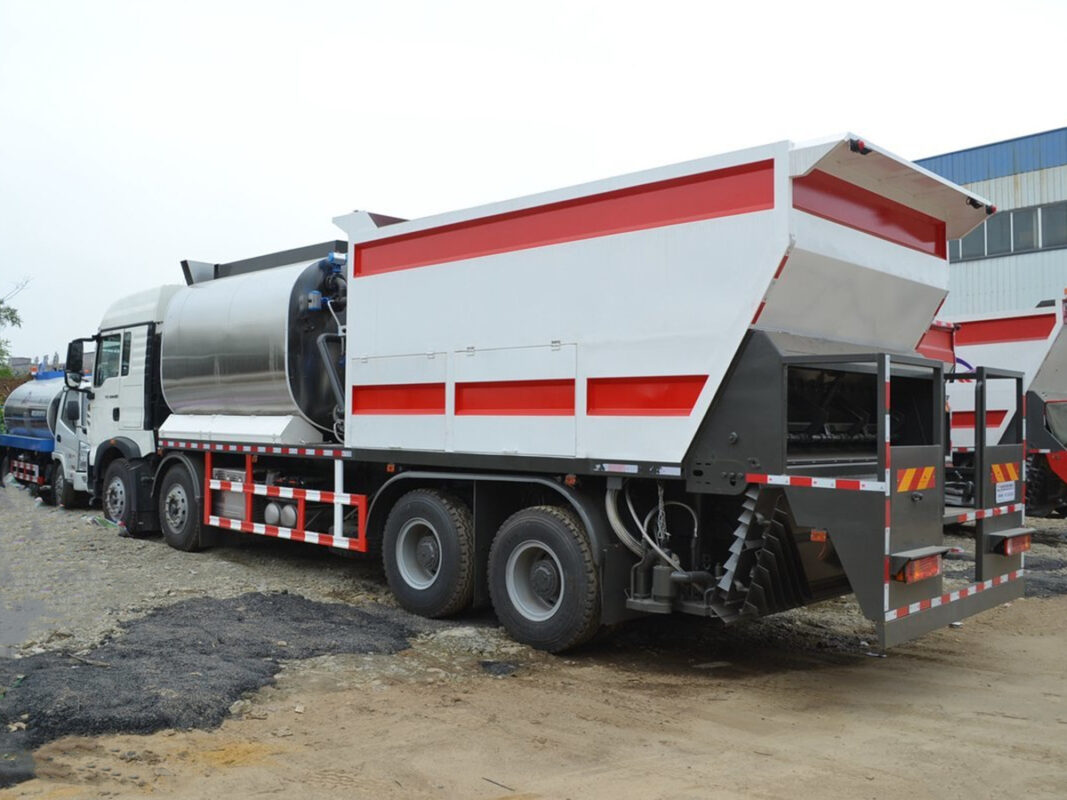
Asphalt distributor trucks stand as engineering masterpieces within construction fleets—specialized machines whose absence cripples foundational roadwork. These vehicles transcend mere transport functions, serving as precision-controlled application systems for binding layers, sealing surfaces, and stabilizing substrates. Their deployment marks the difference between enduring infrastructure and premature pavement failure. Below, we dissect six critical project categories where these technological workhorses prove indispensable.
I. The Technical Anatomy of Modern Asphalt Distributor Trucks
Contemporary units integrate computerized spray control systems with 0.01% emulsion application accuracy, featuring heated tanks maintaining 150–180°F viscosities and multi-nozzle spray bars adjustable from 1–24 feet. Advanced models like Vantrucktrailer’s SmartSpray Series incorporate infrared surface scanners calculating absorption rates in real-time, while regenerative burner systems reduce fuel consumption by 40% compared to conventional units. These capabilities transform raw bitumen or emulsions into uniformly distributed strategic assets—whether applying SS-1h emulsions for chip sealing or PG 64-22 binders for structural layers.
II. Highway Rehabilitation & Expansion Projects
Surface Rejuvenation Protocols
Aging highways demand tack coat application at 0.05–0.15 gal/yd² rates before overlays—a task impossible without distributor trucks’ metered spray capability. The micro-thin bonding layer reactivates underlying pavement, preventing delamination under heavy truck traffic.
Crack Sealing Operations
Thermoplastic rubberized asphalt applied at 325°F through pressurized wands seals fissures against moisture intrusion—a service requiring the truck’s onboard melting kettles and temperature-stable storage.
Rumble Strip Installation
Pre-applying emulsified asphalt beneath milled grooves reduces aggregate dislodgment by 70%, extending strip longevity through freeze-thaw cycles.
III. Municipal Infrastructure Maintenance
Pavement Preservation Programs
Cities deploy distributor trucks for fog seals (0.10–0.25 gal/yd²) and slurry seals—extending pavement life 7–12 years at 20% of replacement costs. Minneapolis’ 2025 initiative preserved 83 lane-miles using this strategy.
Pothole Patching Systems
Spray-injection patching requires simultaneous emulsion application and aggregate placement—a process enabled by trucks with rear-mounted hoppers and dual spray wands.
Bike Lane Weatherproofing
Specialized spray bars apply narrow 4-foot seals along vulnerable curb lanes, preventing edge raveling from de-icing salts.
IV. Industrial & Aviation Sector Applications
Airfield Pavement Management
FAA mandates AC 150/5370-10G compliant rubberized tack coats beneath runway overlays. Distributor trucks achieve the required 97% uniformity coefficient through laser-guided spraying.
Heavy Loading Zones
Port container yards and mill sites require polymer-modified emulsions applied at 0.25 gal/yd² beneath 8-inch concrete slabs to withstand 80,000-pound axle loads.
Fuel Resistance Treatments
Truck stops and aviation refueling zones utilize epoxy-asphalt blends sprayed at 60 psi to prevent hydrocarbon degradation.
V. Specialized Surface Creation
Permeable Pavement Systems
Distributors apply high-float emulsions (HFMS-2s) at 35% residual rates to stabilize porous aggregate bases while maintaining 30% void spaces.
Eco-Friendly Cool Pavements
Titanium dioxide-doped asphalt binders sprayed via infrared-heated bars reduce urban heat island effects by 15°F.
Noise-Reducing Surfaces
Open-graded friction courses require penetration-grade binders sprayed before placing ¾-inch aggregates to create sound-absorbing matrices.
VI. The Future: Integration with Smart Logistics Ecosystems
The next evolution pairs distributor trucks with predictive maintenance algorithms analyzing 12,000 datapoints—from emulsion viscosity to pump wear patterns—slashing downtime by 55%. Emerging autonomous convoy systems will synchronize cargo truck material deliveries, dump truck aggregate placement, and distributor applications via 5G mesh networks. Manufacturers like Vantrucktrailer now develop hybrid-electric chassis with 200-kW export power to operate robotic patching arms and thermal recyclers. This convergence transforms distributed assets into cohesive infrastructure-building organisms—where every drop of emulsion is geo-tagged, every square yard quality-verified through blockchain logging, and every project optimized through digital twin simulations before breaking ground. Pavement construction evolves from reactive repairs to predictive preservation, with distributor trucks serving as the catalytic nexus between sustainable engineering and resilient mobility.