The symphony of road construction relies on countless critical performances, but few are as fundamental – or as easily underestimated – as the precise application of liquid asphalt. Whether it’s a tack coat bonding fresh asphalt layers, a prime coat preparing granular bases, or a surface treatment sealing and renewing an existing pavement, the accuracy and consistency of asphalt distribution dictate the project’s longevity, safety, and ultimate performance. Achieving this precision is far from a simple pour; it demands sophisticated spray systems operating as the meticulous artisans of the paving process. These systems transform raw, viscous binder into an accurately metered, uniformly applied film, ensuring every square yard receives exactly what it needs, no more, no less. The consequences of imprecision – from premature failure and delamination to hazardous slippery surfaces and costly material waste – underscore why these technologies are engineering marvels dedicated to perfection.
The Critical Role of Precision: Beyond Simple Coverage
Applying liquid asphalt isn’t merely about wetting the surface; it’s a science demanding exactitude. An inadequate application rate fails to create the necessary bond, leading to layer separation (delamination) under traffic loads. Conversely, excessive application creates a dangerous lubricating layer between pavement courses, causes bleeding (where excess asphalt rises to the surface creating slick spots), wastes expensive material, and compromises surface texture. Environmental factors like temperature and wind, substrate conditions, and the specific properties of the emulsion or binder itself add layers of complexity. Precision spray systems are engineered to overcome these variables, delivering consistent results regardless of external challenges, ensuring optimal adhesion, waterproofing, and pavement integrity from the ground up.
The Core Technology: Modern Asphalt Distributor Spray Bars
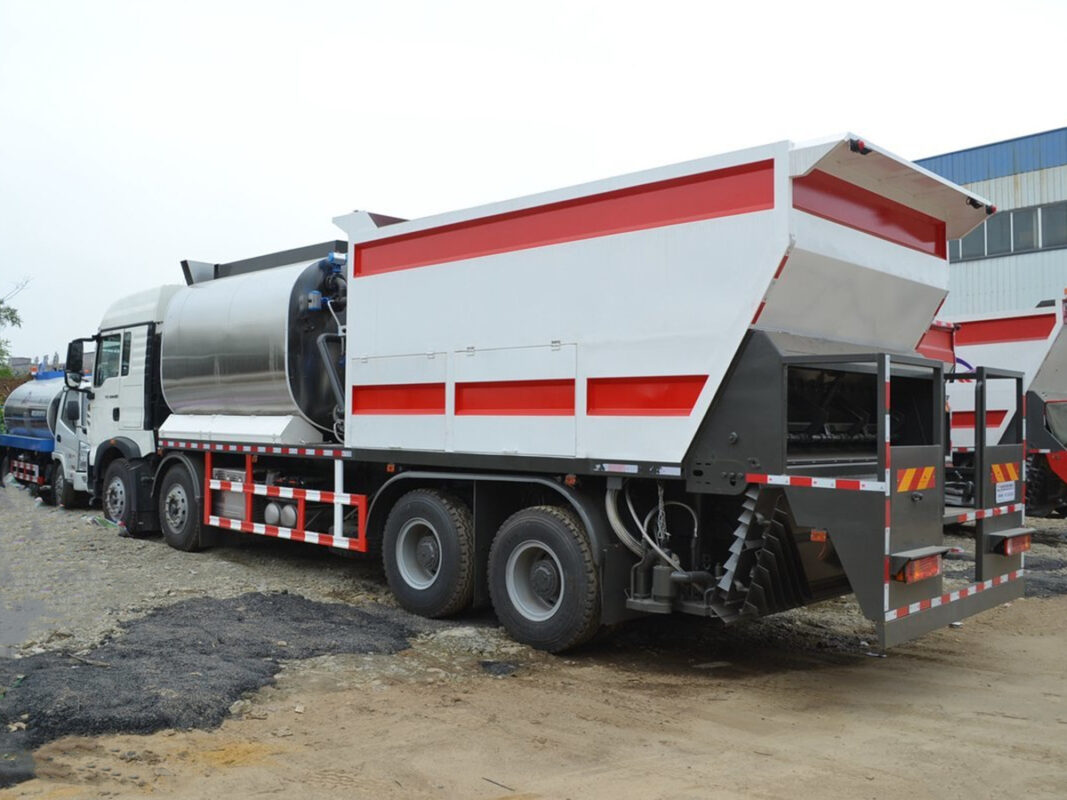
At the heart of precision lies the spray bar, the workhorse component mounted beneath the asphalt distributor truck. Modern spray bars are feats of hydraulic and thermal engineering designed for consistent, controlled discharge:
- Multi-Nozzle Configurations for Uniformity: Instead of a single outlet, spray bars feature numerous precisely spaced spray nozzles along their length. This array ensures overlapping spray patterns, eliminating streaks or gaps and guaranteeing a seamless, uniform film across the entire spray width. The number and spacing are meticulously calculated based on the desired application rate and spray bar height.
- Engineered Nozzle Design: The nozzles themselves are not simple holes. They are carefully engineered orifices, often designed with specific internal geometries (like fan-spray patterns) to produce a consistent, atomized spray pattern at defined pressures. Material compatibility is critical to resist wear from abrasive binders.
- Height Adjustment Mechanisms: Maintaining a consistent distance between the nozzles and the pavement surface is paramount for achieving the designed spray pattern width and overlap. Distributors incorporate robust, often hydraulic, height adjustment systems allowing operators to quickly and accurately set the spray bar height according to job specifications and terrain variations.
Command and Control: The Intelligent Brains of Distribution
Precision spraying transcends mechanical components; it requires sophisticated electronic and hydraulic control systems functioning as the operational intelligence:
Flow Metering & Closed-Loop Control
The cornerstone of accuracy. In-line flow meters continuously measure the actual volume of asphalt passing through the system in real-time. This data feeds into a central control console which compares it instantly against the pre-set target application rate (typically in gallons per square yard, liters per square meter, etc.). If a discrepancy is detected, the system automatically adjusts the pump speed or valve settings to maintain the exact desired rate, creating a closed-loop feedback system.
Ground Speed Compensation
Application rate is a function of both flow volume and the distributor’s travel speed. Integrated ground speed radar constantly monitors the truck’s velocity. The control system uses this data to dynamically adjust the asphalt flow rate on-the-fly. Slowing down automatically reduces flow; speeding up increases it proportionally. This ensures consistent application density regardless of speed variations caused by traffic, terrain, or operator input.
Programmable Application Profiles
Modern consoles offer sophisticated programming capabilities. Operators can input complex spray patterns – defining different application rates for different spray bar sections or specific zones within a pass (e.g., higher rates on edges, lower rates in the center). This is invaluable for intricate work like intersections, bridge decks, or applying variable rates based on pavement condition surveys.
Maintaining the Medium: Thermal Management Systems
Liquid asphalt binders and emulsions are highly temperature-sensitive. Viscosity changes dramatically with temperature fluctuations:
- Precision Heating Systems: Distributors are equipped with powerful, thermostatically controlled heating systems – typically diesel-fired and circulating hot oil through jacketed tanks and spray bar manifolds. Maintaining the binder within a tight optimal temperature range is non-negotiable. It ensures proper fluidity for pumping, accurate metering, effective atomization at the nozzles, and optimal bonding characteristics upon impact.
- Tank Circulation & Agitation: Preventing temperature stratification and material settling is crucial. Recirculation pumps constantly circulate heated binder through the tank and spray system, maintaining uniform temperature and consistency throughout the load. Agitation systems (mechanical paddles or air agitation) prevent separation in emulsions or settling of modifiers.
- Insulation: High-quality thermal insulation on tanks, hoses, and manifolds minimizes heat loss, improving fuel efficiency and maintaining consistent operating temperatures, especially crucial in cold weather or over long haul distances.
Optimizing Atomization: Pressure Regulation & Spray Quality
The quality of the spray pattern – how finely the asphalt is broken up – significantly impacts coverage uniformity and bonding effectiveness:
- Precise Pressure Control: Maintaining consistent spray pressure is vital for achieving the designed atomization and fan pattern from the nozzles. Hydraulic systems incorporate pressure regulators and dampeners to ensure smooth, pulseless flow even as pump demands change. Stable pressure prevents pulsating spray patterns that lead to uneven application.
- Atomization Performance: Proper atomization, achieved through the combination of correct viscosity (via heating), nozzle design, and stable pressure, creates a fine, even mist. This ensures better surface coverage, penetration into the substrate (for prime coats), and faster breaking of emulsions. Poor atomization results in large droplets, streaking, and inadequate bonding.
- Nozzle Clean-Out Systems: Clogged or partially blocked nozzles instantly ruin application uniformity. Distributors feature integrated nozzle purging systems, often using compressed air or solvent, to blast debris from nozzles before, during (if needed), and after spraying, ensuring every nozzle performs optimally.
Operator Interface and Calibration: The Human Factor
Even the most advanced system relies on skilled operation and meticulous maintenance:
- Intuitive Control Consoles: Modern operator interfaces are designed for clarity and ease of use. Touchscreen displays provide real-time feedback on application rate, ground speed, temperature, spray bar status, and system pressures. Alarms alert operators instantly to deviations or faults.
- Rigorous Calibration Protocols: Absolute accuracy demands regular system calibration. This involves verifying the accuracy of the flow meter against a certified standard, checking ground speed radar calibration, ensuring temperature sensors are accurate, and confirming spray bar height settings. Calibration is a scheduled, documented maintenance activity, not an afterthought.
- Operator Training & Best Practices: Technology empowers, but skilled operators are essential. Training must cover system principles, pre-operation checks (nozzle inspection, hose integrity, tank levels), proper startup/shutdown sequences, interpreting console data, troubleshooting common issues, and adhering strictly to job specifications for application rates and patterns.
The Integrated Paving Process: From Distributor to Mat
Precision spraying doesn’t exist in isolation; it’s a vital link in the chain:
- Synchronization with Paving Trains: The asphalt distributor works in concert with other equipment. Timing the application of tack coat immediately before the paver arrives is critical to ensure optimal adhesion while the binder is still active. Communication between crews is essential.
- Material Compatibility: The spray system must handle the specific binder specified – whether it’s hot asphalt cement, a specific emulsion (CSS, CQS), or a polymer-modified binder. System settings (especially temperature) must be adjusted accordingly to maintain the material’s properties during application.
- Feeding the Process: While the distributor applies the binder, the mixer truck delivers the hot mix asphalt (HMA) to the paver. Simultaneously, a dump truck might be hauling away milled material or delivering aggregate for base courses elsewhere on the site. The seamless coordination of these assets – the distributor ensuring a perfectly prepared surface, the mixer truck delivering fresh mix on time, the dump truck managing material flow – underpins the efficiency and quality of the entire paving operation. The distributor’s precision sets the stage for everything that follows.
The intricate ballet of road construction demands that each component performs its role flawlessly. While the roar of the paver and the rumble of the mixer truck capture attention, the quiet precision of the asphalt distributor‘s spray system is foundational. It’s a fusion of mechanical robustness, thermal management, and digital intelligence, all dedicated to placing the right amount of material, in the right place, at the right time. This unseen artistry, perfected through advanced spray systems, is what transforms layers of aggregate and binder into a durable, safe, and long-lasting pavement. It’s engineering precision paving the way for progress.