
Livestock transportation constitutes a critical juncture where agricultural efficiency intersects with profound ethical responsibility. In this mobile microenvironment, hundreds or thousands of sentient beings rely entirely on engineered systems to sustain their physiological equilibrium against the onslaught of external weather volatility, internal metabolic heat production, accumulating moisture, and escalating noxious gases. Ventilation systems within these rolling habitats are not auxiliary components; they are the indispensable respiratory and thermal regulation infrastructure, directly dictating survival rates, stress biomarkers, disease incidence, carcass quality, and compliance with increasingly stringent global animal welfare statutes. The scientific complexity underlying effective trailer ventilation—spanning computational fluid dynamics, species-specific ethology, real-time environmental monitoring, and robust mechanical engineering—reflects an industry acknowledging a fundamental truth: air quality and thermal stability during transit are non-negotiable determinants of biological integrity. As journey durations extend and climate extremes intensify, the evolution from rudimentary airflow to precision-controlled microclimate management represents the frontier of humane and sustainable livestock logistics.
Beyond Oxygen: The Multifaceted Physiology of Ventilation Failure
Inadequate airflow triggers cascading physiological crises with far-reaching welfare and economic consequences:
- Thermal Catastrophe Pathways: Livestock, particularly swine and poultry, possess inherently limited thermoregulatory capacity. When ambient temperatures exceed critical thresholds or humidity saturates the air, heat stress initiates a lethal spiral—accelerated respiration depletes blood bicarbonate reserves inducing metabolic acidosis, cardiac strain escalates, intestinal integrity falters promoting endotoxemia, and cellular apoptosis cascades culminate in multi-organ failure. Conversely, neonatal calves or shorn sheep exposed to unchecked cold stress rapidly deplete glycogen reserves through shivering thermogenesis, suppressing immune function and increasing mortality.
- Toxic Atmosphere Accumulation: Static air permits dangerous concentrations of gaseous and particulate pollutants: ammonia (NH₃) from urea hydrolysis irritates respiratory epithelia and suppresses mucociliary clearance; carbon dioxide (CO₂) from respiration elevates blood pCO₂ causing respiratory acidosis; methane (CH₄) and hydrogen sulfide (H₂S) from anaerobic manure decomposition induce neurological impairment; diesel exhaust particulates infiltrate alveoli; airborne pathogens proliferate in moist, stagnant microclimates. This chemical burden directly compromises pulmonary health and systemic immunity.
- Behavioral Distress Amplification: Animals experiencing thermal discomfort or dyspnea exhibit stereotypic agitation—increased vocalization, futile mounting attempts, destructive pushing—exacerbating traumatic injuries, energy expenditure, and psychological suffering. Overcrowding magnifies these effects, transforming the trailer into a pressure cooker of distress.
Robust ventilation is therefore the primary intervention disrupting these pathological cascades, preserving homeostasis and delivering animals capable of recovery or ethical processing.
Engineering the Airstream: Core Thermodynamic and Aerodynamic Principles
Effective system design transcends mere fan placement, demanding rigorous application of physics:
- Dynamic Air Exchange Rate (AER) Calibration: Fixed AER targets are obsolete. Modern systems modulate hourly air changes (from 40 in cold conditions to >120 during extreme heat) based on real-time sensor inputs of load density, species heat production (e.g., finishing pigs vs. market steers), ambient temperature/humidity, and journey phase (transit vs. stationary hold). Computational models define minimum AERs to maintain critical dew point differentials for evaporative cooling.
- Laminar vs. Turbulent Flow Optimization: While high-speed tunnel ventilation generates turbulent, cooling air currents ideal for heat-stressed hogs, species sensitive to drafts (e.g., day-old chicks, newly shorn lambs) require carefully managed laminar flow patterns. Strategically angled inlet baffles and ceiling diffusers direct air upwards, leveraging thermal buoyancy while minimizing direct drafts on animals.
- Pressure Differential Management: Active exhaust systems create negative internal pressure, powerfully evacuating heat and gases. Outlet capacity (roof vents/fans) must significantly exceed inlet capacity (side openings) to prevent airflow stagnation and ensure uniform flushing—a critical ratio often miscalculated in retrofitted systems.
- Humidity-Driven Control Protocols: Since relative humidity (RH) critically impacts evaporative heat loss (panting efficacy plummets above 70% RH), advanced controllers prioritize RH management alongside temperature, triggering enhanced ventilation or supplemental dehumidification at critical thresholds.
Passive Dynamics: Harnessing Motion and Convection
Passive systems exploit vehicle kinematics and natural thermodynamic forces, offering essential redundancy:
- Intelligent Curtain-Side Architectonics: Beyond basic adjustable PVC curtains, advanced designs incorporate:
- Aerodynamically profiled upper rails minimizing drag.
- Tiered venting allowing lower openings for cool air ingress while upper sections exhaust warm air.
- Automated hydraulic or electric curtain actuators responding to precipitation sensors.
Forward motion generates ram air pressure, forcing air through side inlets, while heated air exits via continuous ridge vents exploiting stack effect.
- High-Efficiency Roof Ventilators: Aerodynamic cowlings enhance exhaust velocity even at low speeds. Wind-driven turbine vents provide continuous extraction during stops. Insulated bases prevent condensation drip onto animals.
- Sub-Floor Convection Channels: Slatted floors enable dense, cooler air to enter laterally, warming as it contacts animals, rising through the load, and exiting via roof vents—creating continuous convective loops independent of vehicle speed. Crucially, manure channels remain separated from living spaces.
While remarkably energy-efficient and mechanically robust, passive systems falter during extended stationary periods or extreme ambient conditions, necessitating mechanical augmentation.
Active Intervention: Guaranteed Airflow Under Adverse Conditions
Mechanical systems provide non-negotiable air exchange when passive forces fail:
- High-Capacity Axial Roof Exhaust Arrays: Strategically spaced, weather-rated IP67 fans (12-36+ per trailer) create powerful negative pressure zones. Variable-speed motors modulated by controllers allow seamless scaling from minimal background exchange to emergency cooling (e.g., 40,000+ CFM total capacity). Redundant motor windings prevent catastrophic failure.
- Directed Positive Pressure Systems: Forcing HEPA-filtered, temperature-conditioned air into specific zones via overhead ducting combats localized stagnation and prevents ingress of road dust or exhaust fumes—critical near trailer noses adjacent to tractor exhaust stacks.
- Integrated Adiabatic Cooling: In arid regions, evaporative cooling pads installed over dedicated inlet plenums drastically reduce air temperature (ΔT up to 15°C) through water evaporation. Requires precise water quality management to prevent biofilm risks.
- Combustion-Free Auxiliary Heating: Electric radiant floor mats or hydronic heating loops powered by vehicle APUs provide safe, moisture-neutral warmth for neonates during winter transit, eliminating the oxygen consumption and humidity spikes of propane heaters.
Active systems mandate robust 24V/48V electrical architectures, often incorporating secondary alternators or lithium auxiliary power systems to sustain operation during engine-off periods.
The Neurobiology of Comfort: Species-Specific Ventilation Imperatives
Physiological and behavioral diversity demands tailored environmental strategies:
- Porcine Thermoregulatory Vulnerability: With minimal functional sweat glands and high metabolic rates, swine rely overwhelmingly on respiratory evaporative cooling (panting). Maintaining dew point depression—the critical temperature-humidity differential enabling evaporation—is paramount. Tunnel ventilation at >2.5 m/sec airspeed maximizes convective heat loss during loading/transport in heat. Conversely, weaned piglets require draft-free zones >28°C to prevent hypothermia. Ammonia targets must remain below 10 ppm to prevent bronchial necrosis.
- Bovine Heat Load Challenges: Cattle generate substantial metabolic heat (up to 1.5 kW per 600kg animal). Heat stress management necessitates high-volume air exchange (>80 AER) combined with strategic misting during stationary loading/unloading. However, direct water spray during motion risks chilling via wind chill. Emphasis on under-floor exhaust to remove dense urine-generated ammonia.
- Poultry Hyper-Sensitivity: Broilers can succumb to heat mortality within minutes. Their immense mass-specific metabolic output demands exceptionally high, uniform airflow velocities (>3 m/sec) throughout stacked modules, often augmented with fogging systems. Dust control via electrostatic precipitation or misting is critical for preventing airsacculitis. Layer pullets require gradual temperature acclimatization during transport to prevent cloacal pecking.
Vehicle Integration: Matching System Capability to Transport Platform
Trailer architecture dictates ventilation performance ceilings:
- Versatile Stock Trailers & Cargo Truck Conversions: Smaller loads (horses, sheep, goats) transported via adapted cargo trucks prioritize robust passive ventilation—multiple roof vents with rain hoods, reinforced sliding side windows with grilles, and optional 12V oscillating auxiliary fans. Durability against animal impact is key. Basic thermostatic fan controllers offer limited active intervention during stops.
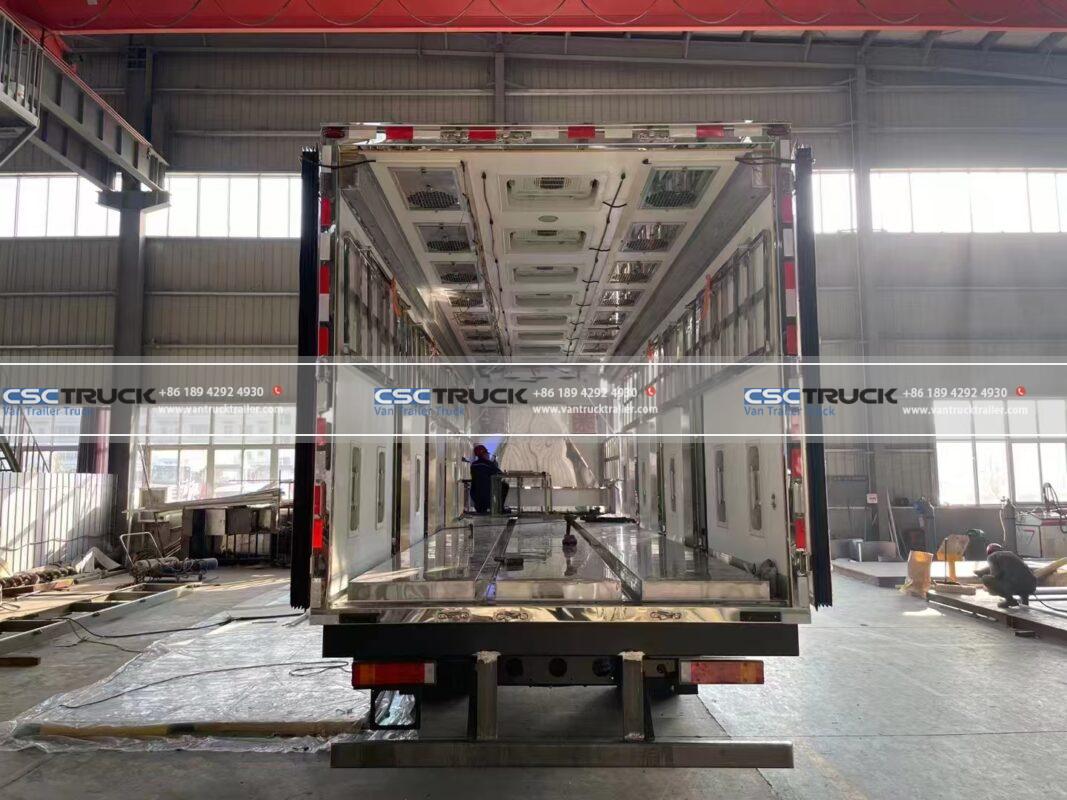
- Optimized Mid-Range Logistics: Dry Van Truck Solutions: Purpose-built livestock bodies on dry van truck chassis enable integrated hybrid systems. These typically feature:
- Continuous-curtain sides with tiered venting options.
- Banks of 3-8 roof-mounted exhaust fans controlled via multi-zone thermostats.
- Insulated roofs/walls reducing solar heat gain.
- Basic NH₃/CO₂ sensors triggering visual cab alerts.
Ideal for multi-species loads (cattle, pigs, small ruminants) on sub-8-hour journeys, balancing welfare adequacy with operational simplicity.
- High-Density, Long-Haul Excellence: Semi-Trailers & Advanced Vantrucktrailers: Multi-deck articulated trailers deploy industrial-grade ventilation:
- Networked, variable-speed fans (10-36 units) with independent deck control.
- Automated curtain systems with wind/rain sensors.
- Multi-point environmental telemetry (T, RH, NH₃, CO₂) feeding cloud-based analytics.
- Supplemental evaporative or adiabatic cooling loops.
Vantrucktrailers—integrating tractor and livestock body into a single rigid commercial vehicle—offer comparable sophistication within a more maneuverable footprint. Their unified chassis facilitates optimized weight distribution for taller ventilation superstructures and simplified power routing for high-amperage systems. This proves indispensable for complex multi-farm collection routes requiring frequent stops, where maintaining stable microclimates despite engine-off periods is non-negotiable. Smart controllers seamlessly transition between motion-exploited passive flow and active mechanical support during stationary phases, ensuring continuity of the air quality parameters upon which animal survival depends.
The trajectory is clear: tomorrow’s systems will leverage predictive analytics, pre-cooling geothermal thermal buffers, and ultra-low-energy air movement technologies, transforming livestock transport from a survival challenge into a scientifically managed continuum of welfare assurance. The air itself becomes the most vital cargo.