Rhythm of Modernization
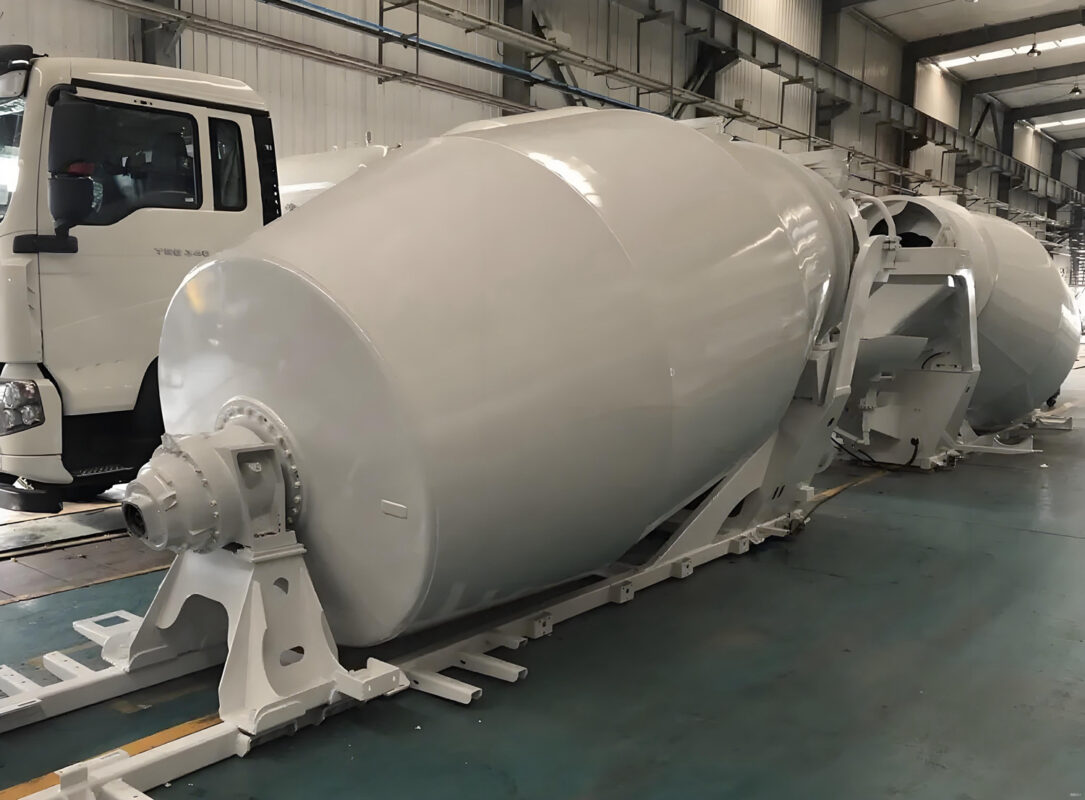
As dawn breaks over a downtown high-rise construction site, a symphony of beeping machinery is punctuated by the distinctive rotating drum of an arriving mixer truck—a vehicle whose significance transcends mere material delivery. These mobile batching plants represent the critical nexus between raw material science and architectural ambition, enabling the fluid metamorphosis of aggregate, cement, and water into structural permanence with unprecedented temporal and spatial precision.
1. The Physics of Transit Mixing: Beyond Simple Agitation
The drum’s rotation is a carefully calibrated thermodynamic process.
Rheological Control
- Variable Drum Kinematics: Hydraulically controlled rotation at 4-8 RPM during transit maintains colloidal suspension of particles, preventing segregation while avoiding over-mixing that induces premature hydration—a balance impossible with static mixing.
- Spiral Blade Optimization: Helical fins with 65° pitch angles create axial movement counteracting gravitational settling, preserving slump integrity across 90-minute delivery windows despite road vibrations.
Environmental Mediation
- Thermal Buffering: Insulated 8-10mm steel drums reduce concrete temperature fluctuation to ±2°C/hour—critical when transporting in 30°C heat where every 5°C increase accelerates setting by 20%.
2. Design Evolution: From Mortar Carriers to Mobile Factories
Modern mixer trucks integrate sophisticated batching capabilities.
Onboard Material Management
- Admixture Injection Systems: Secondary tanks with peristaltic pumps introduce retarders, plasticizers, or accelerators mid-transit, adjusting mix properties in response to real-time site conditions.
- Water Metering Precision: Laser-guided flow sensors enable ±0.5% water/cement ratio accuracy—decisive for achieving 5,000+ PSI compressive strengths.
3. Delivery Precision: The Art of Timed Placement
Coordination between plant and site demands integrated logistics.
Synchronized Workflow Integration
- Telematics Coordination: GPS-tracked trucks synchronize with batch plants and pump operators, reducing idle time by 35% through AI-optimized routing that accounts for traffic patterns and concrete setting profiles.
- Just-in-Time Pouring: Drum reversal at 12-15 RPM discharges 10 cubic yards in under 5 minutes, enabling continuous pours for monolithic foundations exceeding 500 cubic yards without cold joints.
Placement Versatility
- Multi-Angle Discharge: Articulated chutes with 270° rotation and 45° elevation reach obstructed sites, placing concrete within 3-inch accuracy margins even when direct pump access is impossible.
4. Site Transformation: Enabling Architectural Ambition
Mixer trucks catalyze previously impossible construction methodologies.
High-Rise Enablement
- Pump Interfacing: Standardized flange connections interface with boom pumps achieving 200m vertical lifts—making 80-story towers feasible through continuous concrete delivery at 150m³/hour flow rates.
Infrastructure Scale
- Mass Concrete Management: Sequential truck arrivals maintain 7°C differential between pour layers in dam construction, preventing thermal cracking that compromised pre-mixer era projects.
5. Operational Economics: The Calculus of Fluid Logistics
The business case extends beyond material delivery.
Cost Optimization Levers
| Factor | Traditional Site Mixing | Mixer Truck Efficiency |
|---|---|---|
| Labor Requirements | 8-10 workers | 2-3 workers |
| Batch Consistency | ±15% variance | ±3% variance |
| Waste Generation | 12-18% | 4-7% |
Carbon Footprint Reduction
- Centralized Batching: 40% lower cement consumption through optimized mix designs versus decentralized mixing, eliminating 1.2 tons CO₂ per 10 cubic yards poured.
6. Future Trajectory: Automation & Material Science Convergence
Emerging technologies redefine possibilities.
Intelligent Material Systems
- Self-Monitoring Concrete: Trucks delivering mixes embedded with carbon nanotube sensors provide real-time structural health data post-pour, transforming delivery vehicles into diagnostic platforms.
Autonomous Operations
- Driverless Convoys: Platooning 3-4 mixer trucks with lead-vehicle navigation reduces fuel consumption by 22% while maintaining precise 8-minute intervals for mega-project pours.
The Specialized Orchestrator
While dump trucks transport inert earth and standard cargo trucks deliver packaged goods, the mixer truck operates as a mobile reactor vessel where chemistry and physics dynamically interact. Its rotating drum embodies the literal motion of progress—transforming fluid potential into structural reality. Even the most versatile Vantrucktrailer cannot replicate this alchemy; where others carry finished products, mixer trucks deliver the very essence of civilization’s skeleton, one rotating cylinder at a time.