
1. The Invisible Threat in Healthcare’s Backstage
Behind the lifesaving procedures and sterile corridors of modern hospitals lies a perilous logistical challenge: the 14 billion pounds of regulated medical waste generated annually in the US alone, material teeming with bloodborne pathogens, chemotherapy residues, and multidrug-resistant organisms. Traditional manual handling—where healthcare workers transfer sharps containers and biohazard bags through crowded hallways—accounts for over 62% of needlestick injuries and 23% of nosocomial infections traced to waste pathways. The financial toll is staggering: a single contaminated needle-stick incident triggers 3,000–6,000 in immediate testing and prophylaxis, while latent infection cases can incur $1.5 million in long-term treatment costs. Cleveland Clinic’s transition to closed-system waste transfer reduced staff exposure incidents by 91% within 18 months, illustrating the profound safety dividends achievable through reengineering this critical but overlooked workflow.
2. The Automation Evolution: From Manual Handling to Intelligent Ecosystems
Robotic Collection Platforms
The first wave of automation arrived with self-navigating collection carts like Stericycle’s AutoCollector™, equipped with RFID-enabled waste bins that signal fill levels to central dispatch systems. These units traverse pre-mapped hospital routes using LiDAR obstacle avoidance, automatically sealing full containers with vacuum-activated bio-barriers that eliminate aerosolized pathogen release during compression. Massachusetts General’s deployment decreased sharps handling labor by 76% while compressing collection rounds from 8 hours to 2.5 hours daily.
Containerization Revolution
Standardization emerged through ISO-classified waste pods featuring triple-walled construction with absorbent polymer liners capable of neutralizing 98% of liquid contaminants upon contact. Crucially, these containers integrate weight sensors and chemical signature scanners that flag mis-sorted hazardous materials before they enter transport streams. Kaiser Permanente’s SmartCan™ system intercepted 1,200 pounds of improperly discarded chemotherapy waste in 2024 alone, preventing potential groundwater contamination events.
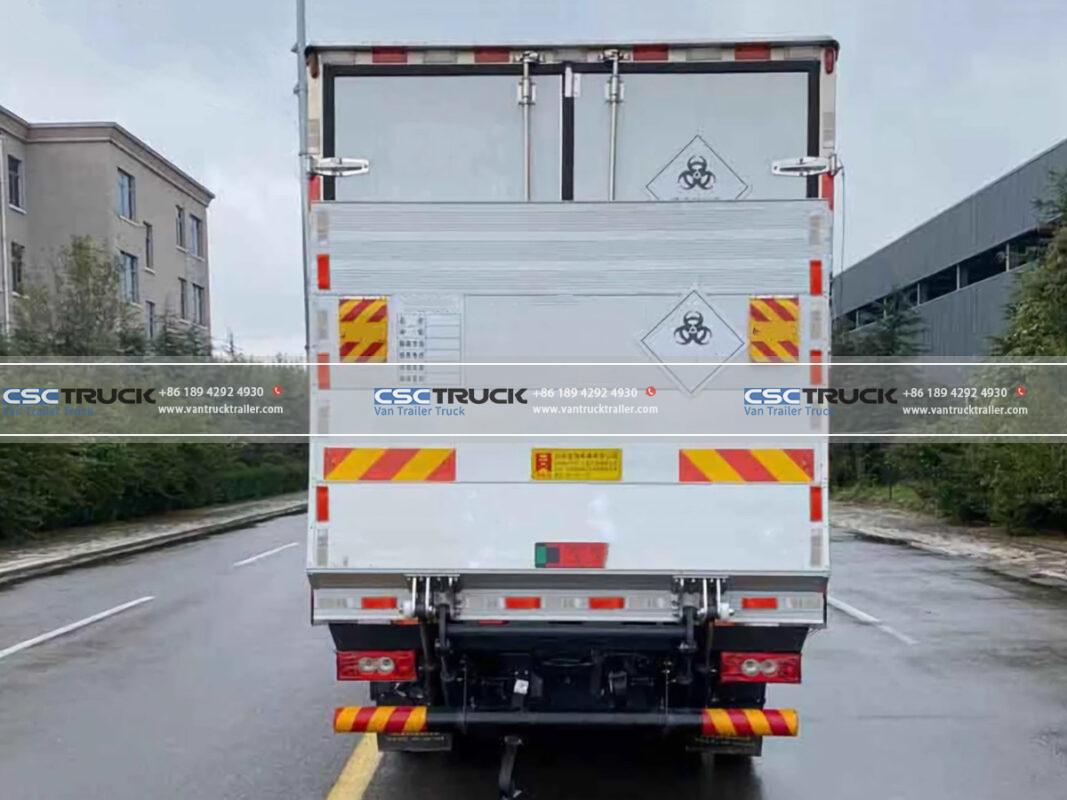
The Rise of the Automated Box Truck
The true paradigm shift materialized with the automated medical waste box truck. Unlike conventional vehicles, these specialized carriers feature internal robotic arms on ceiling-mounted rails that autonomously swap standardized containers. Johns Hopkins’ MedHaul fleet completes loading cycles in 3.7 minutes without human contact—a process that previously required four workers and 22 minutes of hazardous manual labor. Their hermetically sealed cargo bays maintain negative air pressure, ensuring zero environmental release during transit through urban corridors.
3. Intelligent Routing: The Neural Network Backbone
Automation extends beyond physical handling into the cognitive layer of waste logistics. Modern systems leverage predictive contamination modeling that analyzes:
- Real-time infection ward occupancy
- Surgical suite schedules
- Lab test volume analytics
- Historical outbreak patterns
Mayo Clinic’s WasteFlow AI anticipates waste generation spikes with 94% accuracy, pre-positioning collection assets before critical thresholds are reached. During Miami’s 2024 dengue outbreak, the system rerouted 57% of waste transports away from compromised processing facilities within 4 hours of pathogen detection alerts.
Dynamic Risk Mitigation
These fleets employ multi-spectral hazard scanning during transit. Sensors continuously monitor for:
- Gamma radiation leaks (from nuclear medicine waste)
- VOC plumes (indicating chemical breaches)
- Temperature anomalies (suggesting decomposition)
When United Medical Transport’s sensors detected a 0.3°C spike in a pathology waste pod, autonomous systems immediately isolated the container into a cryogenic quarantine chamber, preventing potential anthrax spore activation during a Phoenix heatwave.
4. Sterilization on Wheels: Mobile Treatment Ecosystems
Microwave Disinfection Units
The latest box truck innovations incorporate onboard sterilization. TruGreen’s MobiWave™ trucks use 2.45 GHz microwave arrays generating 96°C steam within rotating chambers, achieving log-6 pathogen reduction in 18 minutes—processing waste during transit to treatment facilities. This technology eradicates the “cold chain” vulnerability of traditional transport, where temperature fluctuations allow pathogen regrowth.
Plasma Torch Destruction
For high-risk waste streams, automated plasma pyrolysis represents the cutting edge. Mounted within reinforced cargo compartments, these 10,000°C arc torches reduce biological materials to inert vitrified slag while capturing emissions through catalytic converters. The University of Tokyo’s pilot fleet processes oncology waste with undetectable cytotoxic residue—revolutionizing chemotherapy disposal safety.
5. Data Sovereignty & Compliance Architecture
Automation enables unprecedented regulatory transparency. Each container’s journey is recorded on HIPAA-compliant blockchains capturing:
- Chain-of-custody timestamps
- Sterilization validation curves
- Geofenced transport corridors
- Handler biometric verification
When FDA investigators traced a 2024 hepatitis C outbreak to improper waste handling, HCA Healthcare’s digital audit trail identified the exact breach point within 37 minutes—a process that previously required 600+ staff hours of manual record review.
Predictive Compliance Enforcement
Machine learning systems now forecast compliance risks by analyzing:
- Waste manifest discrepancies
- Container seal failure rates
- Driver fatigue metrics
- Facility inspection histories
Proactive alerts reduced RCRA violations by 82% across Veolia’s North American network in 2024.
6. The Integrated Biosecurity Ecosystem
The culmination emerges not as standalone vehicles, but as interconnected bio-containment networks. An automated box truck collecting pathology specimens now functions as a mobile biosurveillance unit, its genomic sequencers screening for novel pathogens during transit. Data streams feed into regional public health dashboards, providing early warnings for outbreaks—as demonstrated when Denver Waste Systems’ fleet detected West Nile virus markers 12 days before clinical cases emerged.
Simultaneously, these systems enable resource symbiosis. During Houston’s hospital flooding crisis, medical waste trucks transformed into emergency power stations, their hydrogen fuel cells supporting ICU operations. Their robotic arms distributed medicines from onboard inventories, while sterilization chambers purified floodwater for dialysis units. The vehicles’ autonomous navigation capabilities guided evacuation convoys through submerged streets using sub-meter bathymetric mapping.
This transformation extends beyond healthcare into community resilience. Standardized cargo truck platforms now serve as interchangeable modules within municipal response grids. During wildfires, medical waste units deploy as mobile air quality labs; in pandemics, their sterilization capacity scales for PPE reprocessing. The once-isolated act of waste removal has evolved into a circulatory system for public health—continuously monitoring, neutralizing, and adapting to biological threats wherever they emerge, proving that safety resides not just in hospitals, but in the intelligent systems connecting them.