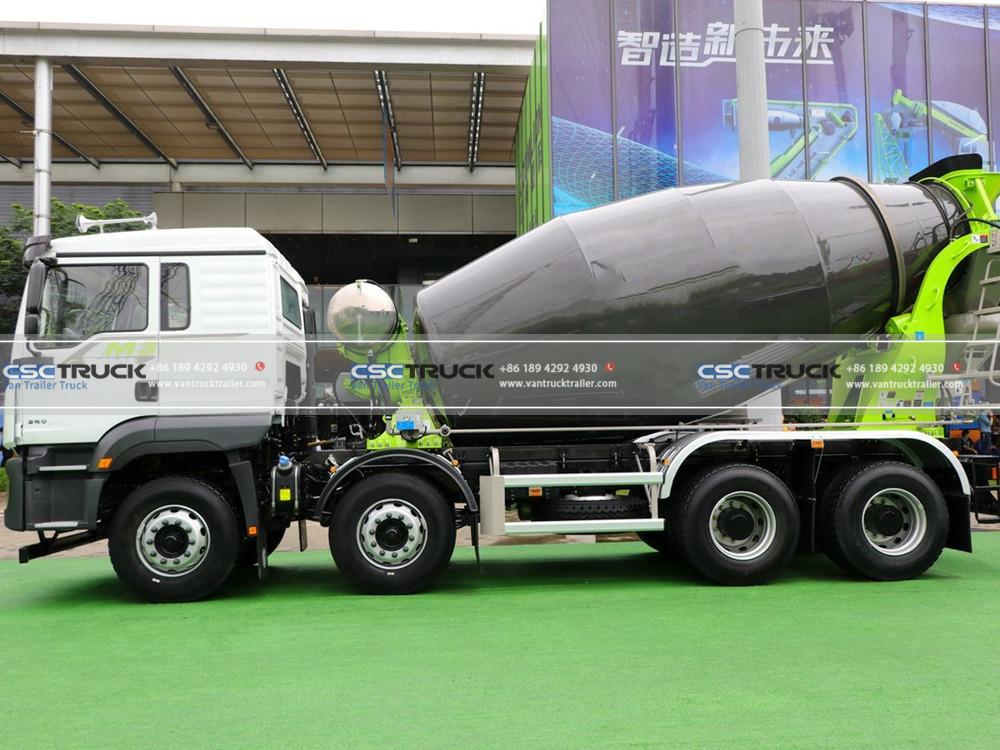
Navigating the intricate ballet of urban construction demands more than brute force; it requires surgical precision. As cities densify and infrastructure ages, placing concrete within their concrete jungles presents unique spatial, temporal, and regulatory challenges. Enter the rear-discharge concrete mixer – an engineering response evolving from niche solution to metropolitan essential. Far from a simple variant of the traditional front-discharge mixer, this configuration fundamentally rethinks the concrete delivery workflow, transforming logistical bottlenecks into seamless workflows and proving indispensable for contractors mastering the complexities of revitalizing our urban cores.
Conquering the Spatial Squeeze: Mastering Confined Urban Sites
The defining constraint of city construction is the acute scarcity of usable space. Rear-discharge mixers excel where traditional equipment falters:
- Minimal Operational Footprint: Unlike front-discharge mixers requiring significant frontal clearance for chute articulation and truck positioning, rear-discharge units utilize a compact rear-mounted discharge system. This allows positioning parallel to the work zone or building face, dramatically reducing the required maneuvering area. Operations become feasible within narrow alleyways, tightly constrained service roads, or directly adjacent to existing structures where space is measured in centimeters, not meters.
- Eliminating the “Swing Zone” Hazard: The rear discharge chute, typically telescopic and articulating via robust hydraulic actuators, directs flow precisely backward or sideways with minimal lateral movement. This removes the dangerous “sweep zone” associated with front chutes swinging over worker heads or adjacent traffic lanes, a critical safety advantage on congested sites.
- Parallel Workflow Integration: Rear discharge facilitates simultaneous operations. While concrete flows directly into forms or pumps from the rear, other trucks (like material delivery or dump trucks) can access adjacent areas via the front or sides without cross-traffic conflicts, optimizing site throughput.
Operational Agility: Speed as a Non-Negotiable Urban Currency
Time lost in urban settings translates directly into amplified costs and community disruption. Rear-discharge mixers accelerate the delivery cycle:
Rapid Positioning & Setup
Drivers can back into position swiftly, guided by sophisticated camera systems. Once aligned, discharge activation is near-instantaneous via intuitive controls, bypassing the time-consuming repositioning and chute extension/retraction sequences common with front-discharge units. Setup often occurs in under two minutes.
Streamlined Pouring Sequences
Multiple rear-discharge mixers can queue efficiently along a linear pour path (e.g., for curb and gutter, utility trenches, or foundation walls). As one completes its discharge, the next seamlessly advances into position, maintaining a continuous flow. This eliminates the “stop-start” rhythm and traffic tangles inherent when front-discharge trucks must repeatedly enter/exit a congested pour area.
Reduced Site Occupancy Time
Faster setup, discharge, and departure minimize each truck’s on-site dwell time. This is crucial for projects impacting high-traffic corridors, emergency access routes, or areas with strictly enforced delivery windows, significantly lowering traffic management costs and community frustration.
Enhanced Safety in High-Risk Environments
Urban sites compound safety hazards with pedestrian traffic, adjacent buildings, overhead utilities, and limited visibility. Rear-discharge design inherently mitigates key risks:
- Predictable Movement Patterns: Movement is primarily linear (backing in, pulling forward). This predictability, combined with restricted chute articulation range, makes vehicle and equipment paths easier for ground crews and spotters to anticipate and manage compared to the complex maneuvering of front-discharge trucks.
- Optimized Driver Visibility: Drivers maintain direct line-of-sight down the truck’s centerline during backing maneuvers, aided by wide-angle rear cameras and radar-based proximity sensors. Critical discharge operations occur directly behind the cab, within the driver’s primary mirrors and camera views, minimizing blind spots near the discharge point.
- Reduced Pedestrian/Worker Interaction: Concentrating discharge activity at the rear, away from the cab and common approach paths, naturally separates flowing concrete from incidental foot traffic or other site activities occurring near the truck’s front or sides.
Precision Placement & Material Control
Urban pours demand accuracy – hitting narrow forms, filling deep foundations without segregation, or feeding stationary pumps efficiently:
- Targeted Discharge: The rear-mounted chute offers superior vertical drop control. Operators can precisely lower concrete directly into deep excavations, utility vaults, or tightly shored foundations with minimal freefall, reducing aggregate separation and ensuring mix integrity upon placement.
- Pump Feed Efficiency: Rear discharge provides the optimal alignment for feeding concrete pumps. The mixer truck positions parallel to the pump, allowing a direct, low-angle chute feed into the pump hopper. This minimizes segregation, reduces spillage around the hopper, and prevents the pump line blockages common with awkward front-discharge angles.
- Reduced Waste & Cleanup: Precise directional control and minimized splatter during discharge, coupled with the ability to position closer to the pour point, drastically reduce concrete spillage on access paths and adjacent surfaces. This translates to less material waste and faster, less resource-intensive site cleanup.
Navigating Regulatory & Community Sensitivities
City projects operate under intense scrutiny regarding noise, emissions, and disruption:
Noise Mitigation Advantages
The primary drum rotation motor and discharge hydraulics are concentrated at the rear. When positioned with the rear facing away from noise-sensitive receptors (residences, hospitals, schools), the truck’s cab and bulk act as a partial sound barrier, reducing perceived noise levels compared to the engine-forward and side-discharge noise profile of traditional mixers.
Emissions Management Flexibility
The compact footprint facilitates easier integration into designated low-emission zones. Some rear-discharge models are available in hybrid-electric or fully electric configurations, leveraging their operational pattern (often involving significant stationary discharge time) for silent, zero-exhaust operation at the point of use – a critical factor for inner-city projects with stringent air quality requirements.
Predictable Traffic Management
Easier integration into pre-planned traffic control schemes, due to linear movement and shorter on-site times, fosters better relations with municipal authorities and communities. This predictability aids in obtaining permits for work in highly restricted areas or during sensitive hours.
Optimizing Fleet Utilization & Site Coordination
Managing multiple deliveries in constrained spaces requires military-grade logistics:
- Standardized Delivery Protocols: Rear-discharge operations create repeatable, reliable patterns. Site supervisors can establish fixed entry/exit routes and discharge zones, simplifying scheduling and coordination for dispatchers managing dozens of daily deliveries across multiple urban projects.
- Compatibility with Site Layouts: The linear “back-in, pour, drive-out” flow integrates naturally with common urban site layouts, such as single-lane access roads or linear construction zones (e.g., road resurfacing, pipeline installation). This minimizes conflict with other site vehicles like dump trucks removing spoil or flatbeds delivering materials.
- Reduced Dependency on Support Equipment: The precision and self-contained nature of rear discharge often reduces or eliminates the need for additional equipment like conveyor belts or transfer buggies to move concrete from truck to placement area, freeing up valuable space and reducing on-site equipment congestion.
The Synergy of Modern Engineering & Urban Imperatives
The rear-discharge mixer truck is not an isolated innovation; it represents a convergence of technologies tailored for the urban battlefield:
- Advanced Telematics Integration: Real-time GPS tracking and site communication systems ensure mixers arrive within precise delivery windows, minimizing queue times. Onboard sensors monitor mix consistency during transit, allowing adjustments via automated admixture injection to compensate for urban traffic delays.
- Robust Chute Design: Modern rear chutes utilize high-strength, abrasion-resistant steels and sophisticated multi-axis hydraulic controls, enabling precise placement at distances exceeding 5 meters laterally or vertically downwards, while handling the high-flow rates demanded by modern high-strength concrete mixes.
- Driver Assist Systems: 360-degree camera systems with AI object detection, automatic drum braking linked to chute position sensors, and stability control systems specifically calibrated for rear-discharge operations enhance safety and precision in the most challenging environments.
Much like the rugged versatility of a traditional dump truck hauling demolition debris or the consistent output of a standard mixer truck servicing suburban sites, the rear-discharge mixer has carved its indispensable niche. It transforms the inherent constraints of urban construction—limited space, intense scrutiny, complex logistics—into manageable variables. This specialized configuration is no longer just an alternative; for projects threading concrete through the intricate veins of our cities, it is rapidly becoming the benchmark for efficient, safe, and compliant delivery, proving that sometimes, the most effective way forward is to look – and pour – decisively backward.