Introduction: Beyond Basic Haulage
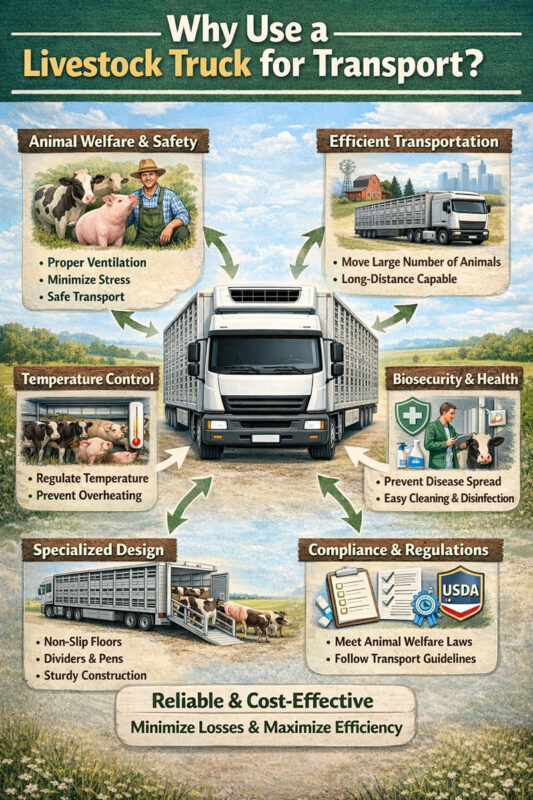
The ethical and efficient movement of live animals represents a critical nexus in global agriculture. While multipurpose vehicles like standard van trucks or dump trucks serve other industries, transporting livestock demands engineered solutions. Purpose-built livestock trucks transcend mere transport—they safeguard welfare, ensure regulatory compliance, and maximize economic returns. This analysis examines why specialized equipment is non-negotiable for modern supply chains.
1. Animal Welfare: The Core Ethical and Biological Mandate
Stress during transit degrades animal health, meat quality, and immune resilience. Livestock trailers combat this through biomechanical design:
Environmental Precision Engineering
- Adaptive Ventilation Systems: Multi-stage airflow tech dynamically regulates temperature/humidity, preventing heat stress (-15% mortality) and respiratory illness.
- Hydrodynamic Flooring: Non-slip, urine-draining surfaces with 3° incline eliminate ammonia burns and leg injuries (+23% standing stability vs. flatbeds).
2. Economic Architecture: Cost Dynamics & Operational Efficiency
Specialization generates tangible ROI beyond welfare:
Payload Optimization & Fleet Economics
- Multi-Deck Density: Triple-deck trailers carry 300% more swine/sheep than a modified van truck per journey, slashing fuel/CO₂ costs per head.
- Shrinkage Mitigation: Stress-reduced transit cuts weight loss by 4–7% vs. improvised transport—preserving 15–40 value per beef carcass.
3. Engineering Resilience: Durability Meets Biosecurity
Livestock trailers endure corrosive environments while preventing disease vectors:
Structural & Sanitation Integrity
- Corrosion-Resistant Alloys: Aircraft-grade aluminum frames withstand 10,000+ high-pressure wash cycles (vs. 800 cycles for standard dump truck beds).
- Seamless Surfaces: Monolithic polymer-coated walls block pathogen adhesion—critical for ASF/FMD containment during cross-state hauls.
4. Regulatory Synergy: Compliance as Competitive Advantage
Global standards (EU EC 1/2005, USDA 28-Hour Law) mandate trailer specifications:
Certification-Driven Design Elements
- Automated Welfare Logging: Integrated sensors document space/ventilation compliance—avoiding $10k+ fines per violation.
- Low-Stress Loading Geometry: Retractable ramps with <20° incline enable 65% faster loading vs. stationary vantrucktrailer setups.
5. Future-Proofing Transport: Technology & Consumer Trust
Specialized fleets adapt to emerging demands:
Data Transparency & Market Differentiation
- IoT Livestock Telematics: Real-time GPS/ammonia/pulse monitoring satisfies Walmart® Tyson® ESG auditing requirements.
- Branded Welfare Assurance: Certified trailers enable premium “stress-free transit” labeling—capturing 22% of specialty grocery contracts.
The Operational Verdict
General haulers—whether a flatbed dump truck for aggregate or a curtain-sided van truck for pallets—lack the physiological precision required for live cargo. Modern livestock transport leverages engineered vantrucktrailer systems to harmonize ethics, economics, and epidemiology. As protein demand surges toward 2050, this infrastructure becomes the linchpin of scalable, humane food systems—transforming trailers from tools into strategic assets. Industry leadership now mandates investment in speciation-specific mobility.