Across Central America, infrastructure investment is accelerating.
Governments are expanding highways, upgrading logistics corridors, modernizing ports, and investing in public utilities to support long-term economic growth. Among these countries, Costa Rica has emerged as one of the region’s most active infrastructure development markets.
But while large projects often focus on heavy equipment, transport fleets, and construction capacity, another challenge is becoming increasingly important:
field maintenance efficiency.
As infrastructure networks expand, equipment downtime becomes more expensive, especially in regions where access to centralized repair facilities is limited. This is one reason why mobile workshops are gaining attention across construction, utilities, mining support, and municipal service sectors.
They are no longer viewed simply as service trucks.
They are becoming mobile operational hubs.
Infrastructure Growth Is Changing Fleet Demands
Costa Rica’s infrastructure development is creating new operational pressures for contractors and public service operators.
Projects increasingly involve:
- Remote highway construction
- Mountain terrain operations
- Port logistics expansion
- Utility maintenance across dispersed regions
- Large municipal maintenance zones
Under these conditions, traditional maintenance models become inefficient.
Sending equipment back to a central workshop can mean:
- Lost production hours
- Delayed project schedules
- Higher transport costs
- Increased fleet downtime
For contractors operating in remote or high-utilization environments, downtime quickly becomes more expensive than repair itself.
This is where mobile workshop vehicles are changing operational strategy.
What Is a Mobile Workshop?
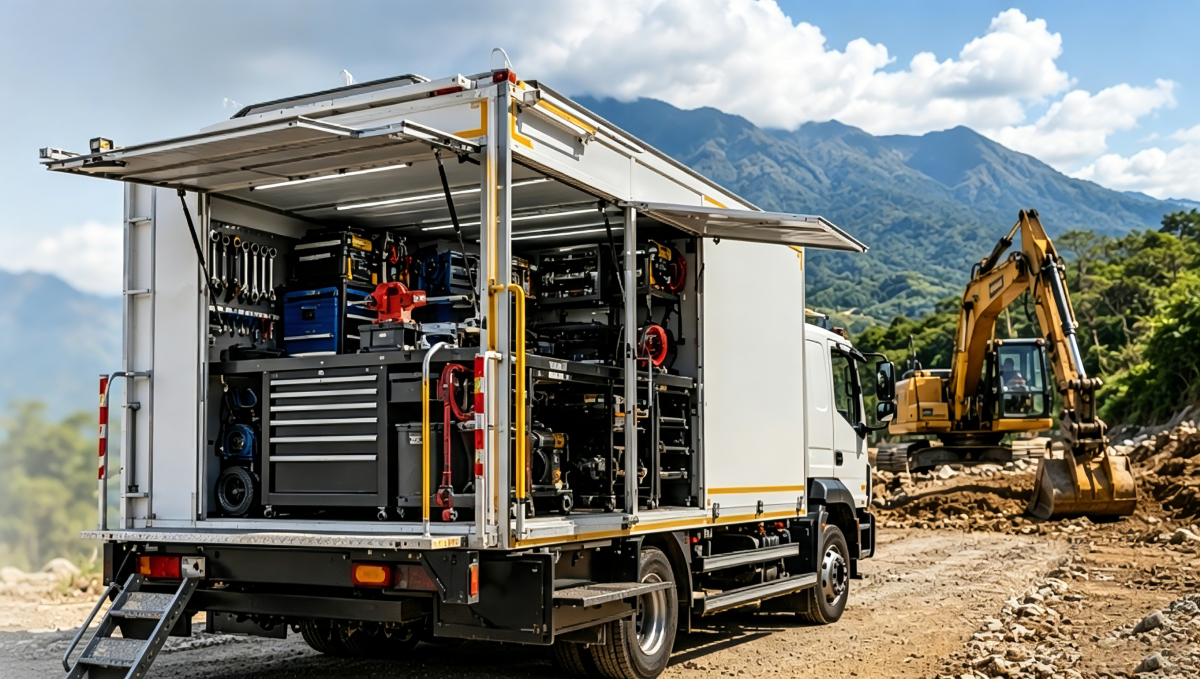
A mobile workshop truck is essentially a fully equipped repair and maintenance unit built into a commercial vehicle platform.
Depending on the application, it may include:
- Tool storage systems
- Hydraulic equipment
- Compressors
- Welding systems
- Generators
- Lubrication systems
- Spare parts compartments
- Diagnostic equipment
- Power management systems
Some advanced units function almost like miniature field service centers.
Instead of bringing equipment to the workshop, the workshop goes directly to the equipment.
This significantly reduces:
- Equipment transport time
- Emergency repair delays
- Technician travel inefficiency
- Fleet idle time
Why Costa Rica Is a Strong Market for Mobile Workshops
Several operational realities make Costa Rica particularly suitable for mobile maintenance solutions.
1. Geographic Complexity
Costa Rica’s terrain creates logistical challenges for fleet operators.
Mountain roads, coastal regions, remote construction zones, and dispersed utility infrastructure often make centralized servicing inefficient.
A mobile workshop allows technicians to perform:
- Preventive maintenance
- Hydraulic repairs
- Electrical diagnostics
- Emergency servicing
directly on-site.
For fleets operating across difficult terrain, this can dramatically improve fleet uptime.
2. Growing Construction and Utility Activity
As infrastructure spending increases, contractors face pressure to keep equipment utilization high.
Idle machinery on a road project or utility operation can disrupt entire project schedules.
Mobile workshops support:
- Faster repair response
- Reduced equipment transport
- Better maintenance scheduling
- Improved fleet productivity
For large projects, even small reductions in downtime can create substantial cost savings over time.
3. Limited Availability of Specialized Service Centers
In many regions across Central America, heavy equipment service networks are still developing.
Operators may face:
- Long parts delivery times
- Limited technician availability
- Overloaded repair facilities
Mobile workshop fleets help bridge this gap by decentralizing maintenance capability.
This becomes especially valuable for:
- Municipal fleets
- Utility operators
- Construction contractors
- Agricultural equipment fleets
The Shift From Reactive Maintenance to Fleet Uptime Management
Traditionally, many operators approached maintenance reactively:
Equipment breaks first, repairs happen later.
But modern fleet management increasingly focuses on:
- Predictive maintenance
- Uptime optimization
- Lifecycle cost control
- Field service efficiency
Mobile workshops play a major role in this transition.
Instead of waiting for catastrophic failures, technicians can perform:
- Scheduled inspections
- Preventive servicing
- Minor repairs
- Fluid replacement
- Component diagnostics
before downtime escalates.
The result is not just lower repair costs.
It is improved operational continuity.
Final Thoughts
As infrastructure investment expands across Central America, maintenance efficiency is becoming a major competitive advantage.
For operators in Costa Rica, mobile workshops are increasingly shifting from optional support vehicles to essential operational assets.
The reason is simple:
Modern infrastructure projects depend on fleet uptime.
And in industries where delays are expensive, the ability to bring maintenance capability directly into the field can fundamentally improve:
- Fleet performance
- Project timelines
- Equipment availability
- Long-term operating cost efficiency
If you are looking for a reliable mobile workshop truck solution for infrastructure, construction, or fleet maintenance, CSCTRUCK provides customized mobile service vehicles to improve uptime and reduce downtime.
Contact us for more information and tailored solutions.