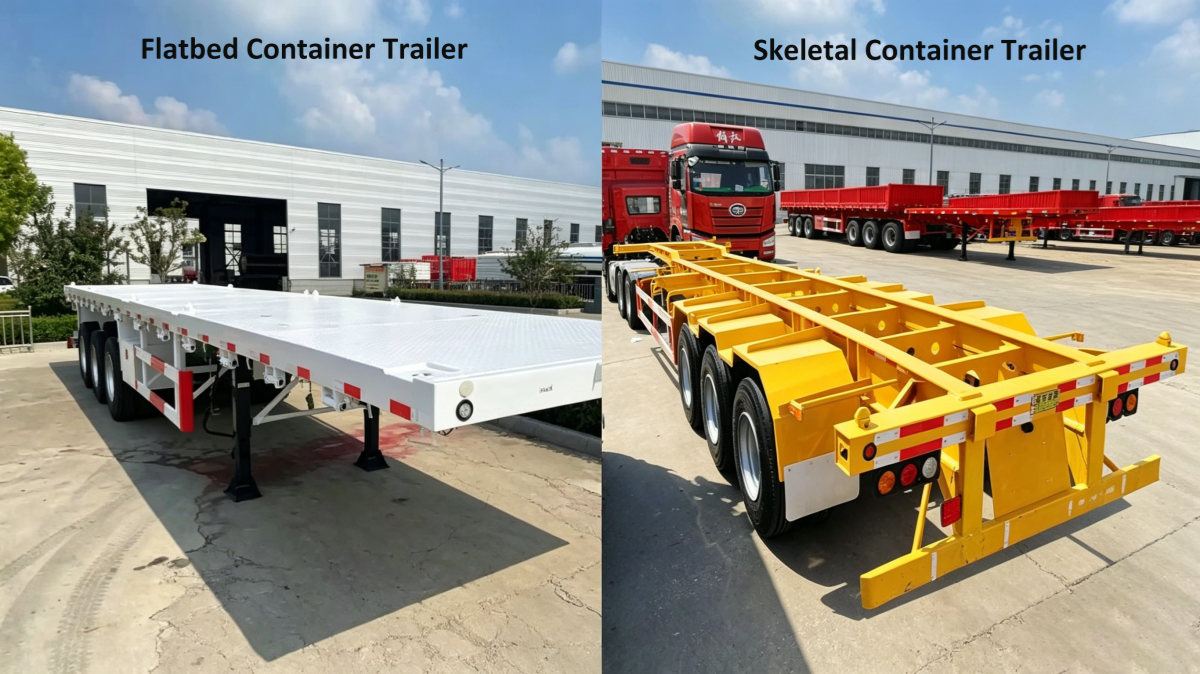
In modern logistics, container types are far more diverse than the standard sealed steel box most people imagine. Among the specialized equipment used for heavy, oversized, or irregular cargo, flatbed and skeletal container trailers play a crucial role. While they may look similar at first glance, their structure, purpose, and operational use cases are quite different.
This blog explores the key differences between these two container types and how they are applied in global transportation systems.
What is a flatbed container trailer?
A flatbed container trailer is a specialized shipping container that has:
- A strong base (floor structure)
- Fixed or collapsible end walls
- No side walls and often no roof
Key Characteristics
Flatbeds are designed to carry cargo that cannot fit inside standard containers. The open sides allow loading from the top or sides using cranes or forklifts.
Some flatbeds also have collapsible end walls, making them easier to stack when empty.
Typical Cargo
- Heavy machinery (excavators, bulldozers)
- Industrial equipment
- Large pipes and steel structures
- Vehicles and boats
Main Advantage
The biggest advantage of flat racks is flexibility for oversized cargo. They are ideal when the width or height exceeds standard container dimensions.

What is a skeletal container trailer?
A skeletal container trailer, often referred to as a container chassis or skeletal trailer, is essentially a wheel-based steel frame used to transport standard containers.
Unlike flatbeds, skeletal container trailers:
- Have no walls, roof, or fixed cargo space
- Are not used to hold cargo directly
- Serve as a transport platform for ISO containers
Key Characteristics
- Designed for the road transport of containers
- Equipped with locking mechanisms (twist locks)
- Attached to trucks for intermodal movement
Typical Cargo
Instead of carrying goods directly, skeletal trailers carry:
- 20ft / 40ft standard containers
- Refrigerated containers (reefers)
- Tank containers
Main Advantage
Their strength lies in intermodal flexibility, allowing seamless transfer between ships, trucks, and rail systems.

Key Differences Between Flat Rack and Skeletal Containers
| Feature | Flatbed Container Trailers | skeletal container trailers |
|---|---|---|
| Structure | Base + end walls (sometimes collapsible) | Steel frame chassis only |
| Cargo Type | Direct cargo loading | Carries ISO containers only |
| Side Walls | None | Not applicable |
| Main Use | Oversized or irregular cargo | Transport of standard containers |
| Loading Method | Crane or forklift loading cargo directly | The container is locked onto the chassis |
| Transport Role | Cargo carrier | Transport support equipment |
Applications in Global Logistics
1. Flatbed Applications
Flatbeds are widely used in industries dealing with non-standard cargo:
Construction Industry
Transporting cranes, steel beams, and prefabricated structures.
Energy Sector
Moving wind turbine parts, generators, and drilling equipment.
Automotive & Marine
Shipping boats, yachts, and oversized vehicles.
Because of their open design, flatbeds are essential for cargo that cannot be disassembled or containerized.
2. Skeletal Container Applications
Skeletal trailers are the backbone of inland container logistics.
Port Operations
They transfer containers between ships and storage yards.
Rail & Road Intermodal Transport
Used to move containers across long distances without unpacking goods.
Distribution Hubs
Enable fast container repositioning in logistics centers.
Their role is not about the cargo itself, but about efficient container mobility.
Operational Considerations
For Flatbed Container Trailers
- Cargo must be securely lashed due to the open structure
- Weight distribution is critical
- Weather exposure requires protective wrapping
For Skeletal Container Trailers
- Requires proper locking of ISO containers
- Must comply with road axle weight regulations
- Often paired with tractor units for mobility
Conclusion
Although both flatbed and skeletal container trailers are essential in global shipping, they serve fundamentally different purposes:
- Flatbed container trailers solve the problem of transporting oversized or irregular cargo.
- Skeletal container trailers enable efficient movement of standard shipping containers across transport networks.
Understanding their differences helps logistics planners choose the right equipment, improving efficiency, safety, and cost-effectiveness in supply chain operations.
Looking for Reliable Container Transport Solutions?
For modern logistics and oversized cargo transportation, choosing the right equipment is essential for improving transport efficiency and cargo safety.
Whether for heavy machinery shipping, port operations, or intermodal freight transport, both Flatbed and Skeletal Container Trailers provide reliable solutions for global logistics projects.
For professional container and logistics transport solutions, CSCTRUCK Vantrucktrailer provides customized Flat Rack Containers, Skeletal Trailers, and specialized transport equipment for various shipping needs.
Contact CSCTRUCK to learn more about efficient container transportation solutions.