
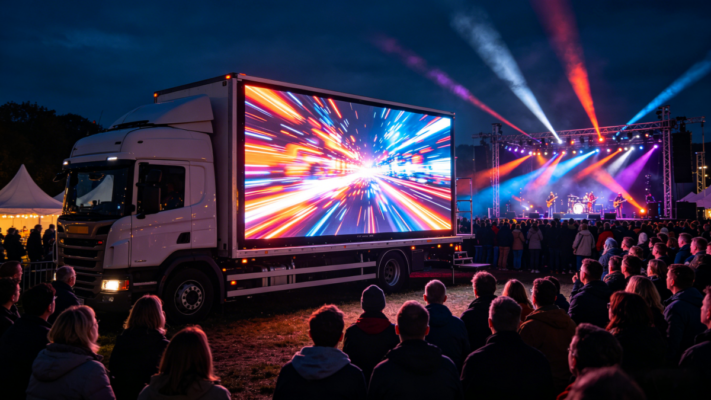
Outdoor mobile LED trucks‘ screens (such as advertising trucks, trailer displays, and stage LED walls) are built by combining three core systems:
- Display system (brightness + pixel pitch)
- Structural system (shockproof + waterproof design)
- Power & control system (energy supply + signal processing)
Below is a deeper breakdown of the three key technical factors.
1. Brightness: Visibility Under Sunlight
Why brightness matters
Outdoors, the biggest challenge is not resolution—it’s sunlight visibility.
A screen must remain visible under:
- Direct sunlight
- Strong ambient light
- Day/night transitions
If brightness is too low, even a high-resolution screen becomes unreadable.
Measurement unit
Brightness is measured in:
Nits (cd/m²)
Typical brightness levels
| Type | Brightness |
|---|---|
| Indoor LED screens | 800–1,500 nits |
| Standard outdoor screens | 5,000–8,000 nits |
| High-end mobile LED screens | 6,000–10,000+ nits |
How high brightness is achieved
LED chip technology
- High-efficiency SMD or COB LEDs
- Higher current tolerance
Driver IC optimization
- Improved scanning performance
- Stable current control
Thermal management
- Aluminum cabinet heat dissipation
- Cooling fans
- Automatic brightness reduction at high temperatures
Trade-offs of high brightness
Higher brightness also means:
- Higher power consumption
- More heat generation
- Potentially shorter LED lifespan
So manufacturers must balance brightness vs durability vs energy use.
2. Pixel Pitch: Image Clarity vs Viewing Distance
What pixel pitch means
Pixel pitch is the distance between two LED pixels, measured in millimeters (mm).

Key rule:
- Smaller pitch = higher resolution (clearer image)
- Larger pitch = better for long-distance viewing
Common outdoor mobile LED pixel pitches
| Pixel Pitch | Best Viewing Distance | Typical Use |
|---|---|---|
| P2.5 – P3.0 | 2–5 meters | Close-range events, premium ads |
| P3.9 – P4.8 | 5–15 meters | Advertising trucks (most common) |
| P5 – P6 | 10–30 meters | Medium-distance displays |
| P8 – P10 | 30m+ | Highway billboards |
Viewing distance rule of thumb
Minimum viewing distance (meters) ≈ Pixel pitch (mm) × 1–2
Example:
- P4 → best viewed from ~4–8 meters
- P10 → best viewed from ~10–20+ meters
Why pixel pitch cannot be too small
Smaller pitch increases:
- Cost (more LEDs required)
- Power consumption
- Heat generation
- Processing load
3. Durability: Built for Weather and Movement
Outdoor mobile LED screens must survive both environmental conditions and transportation stress.
IP rating (water & dust protection)
Standard requirement:
IP65 or higher
- IP6X = completely dust-tight
- IPX5 = water jet resistant
- Higher ratings = better waterproofing
Shock and vibration resistance
Since the screen is mounted on vehicles, it must handle:
- Road vibration
- Sudden braking forces
- Uneven terrain movement
Engineering solutions include:
- Reinforced aluminum cabinets
- Locking module structures
- Anti-vibration mounting frames
- Secure fastener systems
Temperature management
LED screens are sensitive to:
- High temperatures
- Rapid temperature changes
Solutions:
- Built-in cooling fans
- Intelligent temperature sensors
- Automatic brightness adjustment
Waterproof and sealing design
Key features:
- Fully sealed LED modules
- Waterproof power boxes
- Industrial-grade connectors
- Rubber sealing rings
Power stability
Mobile LED screens typically use:
- Vehicle generators
- External power supply
- Battery energy systems (in advanced setups)
They must handle:
- Voltage fluctuations
- Sudden power loss protection
4. How the Three Factors Work Together
| Factor | Benefit | Trade-off |
|---|---|---|
| High brightness | Better daylight visibility | Higher power + heat |
| Small pixel pitch | Sharper image | Higher cost |
| Strong durability | Reliable outdoor use | Heavier structure |
Why Mobile LED Screens Are Technically Special
Unlike fixed LED billboards, mobile systems must:
- Maintain stability while driving
- Prevent pixel misalignment due to vibration
- Support frequent setup and teardown
- Operate on mobile power systems
This makes them closer to industrial equipment than simple displays.
Summary
Outdoor mobile LED screens are designed to:
- Fight sunlight with ultra-high brightness
- Balance clarity and cost with pixel pitch
- Survive weather, vibration, and transport stress
CSCTRUCK also provides other high-quality vehicles.