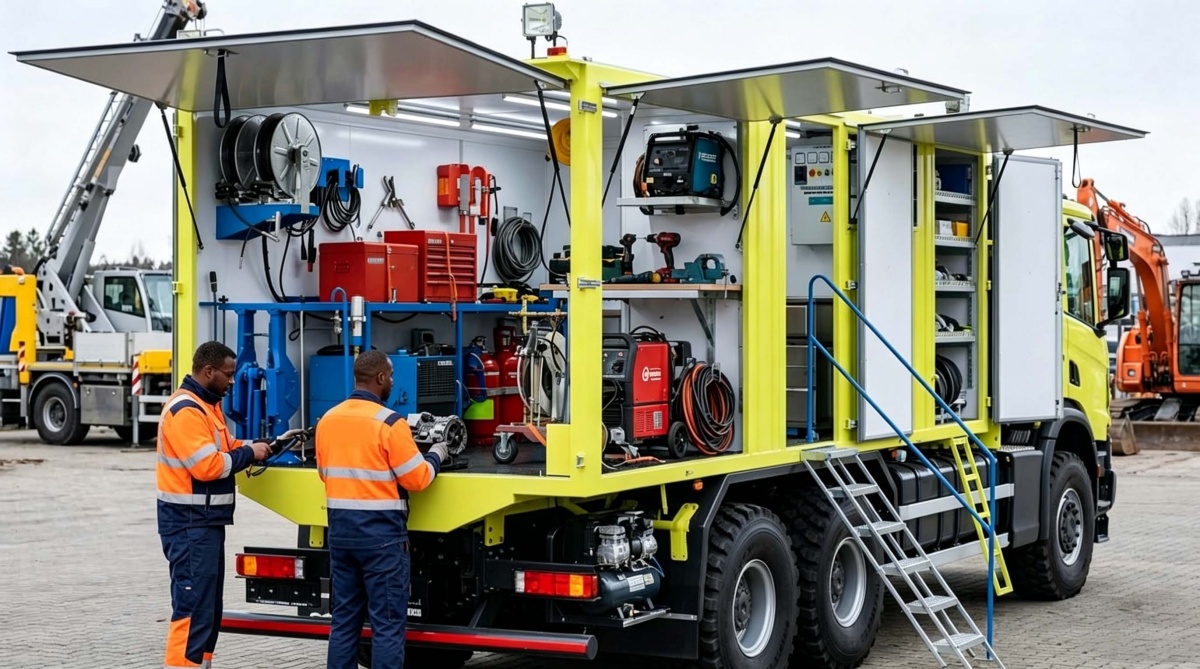
In South Africa’s mining industry, productivity is tightly bound to one critical factor: uptime. From deep underground shafts to surface processing facilities, every minute of equipment downtime translates into lost output, delayed logistics, and significant financial impact. To address this challenge, mining operators are increasingly relying on Mobile Repair Trucks—fully equipped workshops on wheels designed to bring maintenance directly to where breakdowns occur.
This article explores how mobile maintenance solutions are transforming mining operations by reducing shaft-to-surface downtime, improving safety, and increasing operational resilience across remote and high-demand sites.
The Mining Downtime Challenge: From Shaft to Surface
Mining operations in South Africa often span extreme environments—from deep underground shafts reaching kilometers below ground to expansive surface mines. Equipment such as haul trucks, drilling rigs, and conveyor systems operates under constant stress.
When a breakdown occurs, traditional maintenance workflows require:
- Transporting technicians and tools from central workshops
- Waiting for spare parts delivery
- Moving large equipment to repair facilities
This creates significant shaft-to-surface downtime, especially when machinery failure happens underground or in remote pits.
Even a few hours of downtime can cascade into:
- Reduced ore output
- Delayed processing schedules
- Increased labor and fuel costs
- Higher equipment wear due to rushed recovery operations
In mining, time truly equals money.
How Mobile Repair Trucks Reduce Shaft-to-Surface Downtime
The key advantage of Mobile Repair Trucks lies in their ability to eliminate unnecessary transport delays.
On-Site Response
Instead of moving broken equipment to a central workshop, technicians move directly to the failure point—whether deep in a shaft or at a remote surface pit.
Faster Diagnostics
Onboard diagnostic systems allow immediate identification of faults in engines, hydraulics, and electrical systems.
Immediate Repairs
Minor and moderate repairs can be completed on-site, including:
- Hydraulic hose replacement
- Electrical rewiring
- Tire and suspension repairs
- Welding structural components
This dramatically reduces downtime associated with equipment relocation.
Reduced Dependency on Central Workshops
By decentralizing repair capability, mines reduce congestion at fixed maintenance facilities.
Operational Benefits for South African Mines
South Africa’s mining sector—particularly in platinum, gold, and coal—faces unique operational challenges including deep mining depths, aging infrastructure, and remote site locations.
1. Reduced Equipment Downtime
The most immediate benefit is a significant reduction in shaft-to-surface downtime, allowing continuous production cycles.
2. Improved Fleet Availability
Higher uptime means more consistent availability of haul trucks, drills, and loaders.
3. Cost Efficiency
Reducing the transport of heavy equipment to workshops saves:
- Fuel costs
- Crane and lifting operations
- Labor hours
- Logistics coordination expenses
4. Enhanced Safety
Moving damaged equipment through narrow shafts or rugged terrain increases accident risks. On-site repairs reduce the need for hazardous transport operations.
5. Extended Equipment Lifespan
Timely maintenance prevents minor faults from escalating into major mechanical failures.
Mobile Maintenance in Underground vs Surface Operations
Mining environments vary significantly, and Mobile Repair Trucks are adapted accordingly.
Underground Mining
In deep shafts, space constraints and ventilation challenges require compact, high-efficiency mobile units. These trucks are often equipped with:
- Low-emission engines or electric systems
- Compact tool layouts
- Enhanced lighting for confined environments
Surface Mining
Open-pit operations allow larger, more fully equipped mobile workshops capable of handling heavy-duty repairs, including engine rebuilds and structural welding.
The flexibility of mobile units ensures coverage across both environments without infrastructure duplication.
The Strategic Role in South Africa’s Mining Future
The adoption of Mobile Repair Trucks represents more than a logistical improvement—it reflects a strategic shift in how mining operations are managed.
As mines go deeper and equipment becomes more complex, centralized maintenance models struggle to keep up with operational demands. Mobile systems bring maintenance closer to production, aligning directly with the industry’s need for:
- Higher productivity
- Lower downtime
- Greater operational flexibility
In a competitive global commodities market, even small gains in uptime can translate into significant economic advantages.
Conclusion: Bringing the Workshop to the Mine
The concept of Mobile Repair Trucks is reshaping how South Africa’s mining industry approaches maintenance. By eliminating unnecessary equipment transport and enabling rapid, on-site repairs, these mobile units dramatically reduce shaft-to-surface downtime.
As mining operations continue to expand in scale and complexity, the ability to “bring the workshop to the problem” is becoming not just efficient—but essential.
In the evolving landscape of modern mining, mobility is maintenance, and maintenance is productivity.